Application-Centric Medical Aesthetics Engineering
Brief Information of Coligh cooperation with aesthetic medical lasers.
Microarray lenses and diffractive optical elements are core components of medical aesthetic laser instruments. Our company has collaborated with medical aesthetic instrument manufacturers in Israel, South Korea, and mainland China to provide high-quality microarray lenses and diffractive optical elements.
Micro-Lens Array (MLA) Product Overview
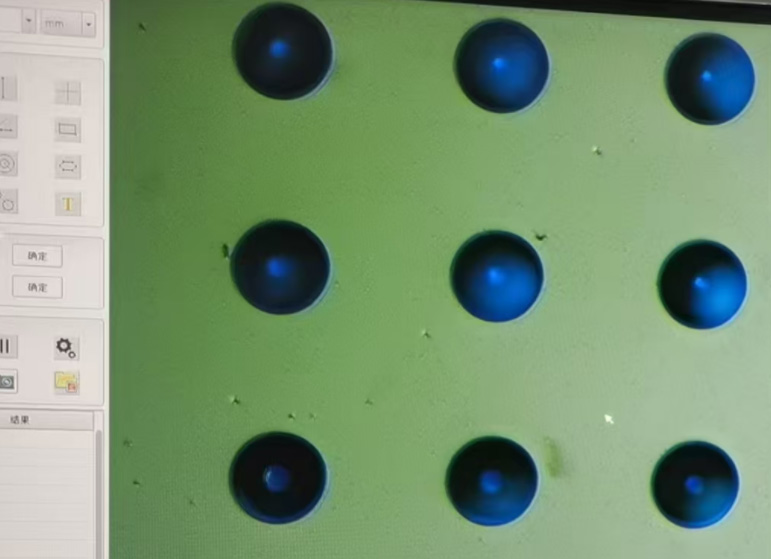
The micro-lens arrays produced by our company are primarily composed of tiny convex lens units. Due to limitations in machinery and manufacturing processes, we have not yet commenced production of concave lens micro-lens arrays. Micro-lens arrays can reshape irregular Gaussian beams into flat-top beams and homogenize the spot size of laser beams. Currently, we can provide spherical, aspherical, or free-form micro-lens arrays, with micro-lens types including honeycomb, circular, or free-form configurations.
Diffractive Optical Eelement (DOEs) Product Overview
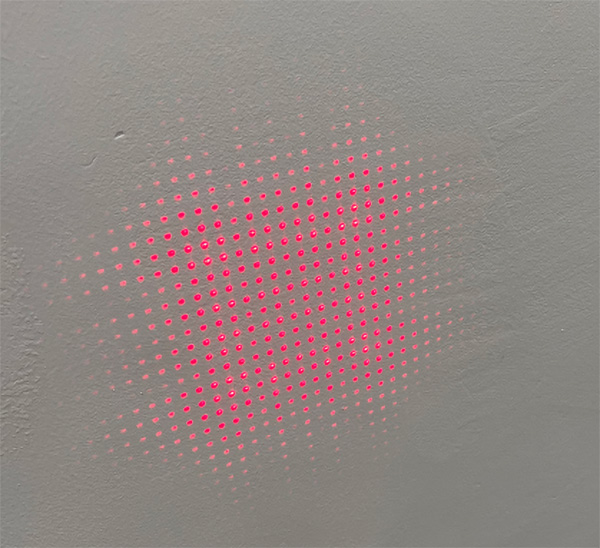
Diffractive optical elements (DOE) utilize the principle of light diffraction to alter the amplitude and phase of a light beam. In medical aesthetic instruments, two-dimensional diffractive optical beam splitters are primarily used. These splitters can shape and split a laser beam into a regular array of spots along the X and Y axes. Currently, our company offers two-dimensional beam splitters with up to 33×33 laser dot arrays for the medical aesthetic industry. We can also provide sub-beams that convert a single laser beam into circular, square, or rectangular dot patterns.
Aesthetic Medical Laser Wavelengths We Involved
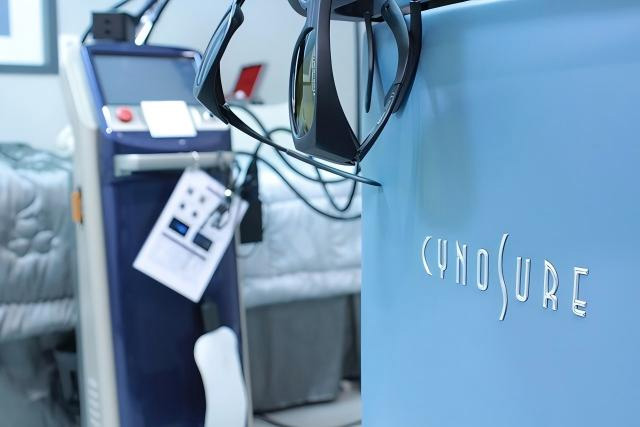
Currently, aesthetic laser treatments in the medical aesthetics field are primarily divided into two modes:
The first is fractional laser: This mode creates microscopic thermal damage zones on the skin, which are then repaired by the skin’s natural healing process, resulting in the formation of newer, more youthful skin.
The second is beam shaping for non-fractional treatments. In non-fractional treatments such as pigmentation or hair removal, uniformly distributed flat-top spot patterns can prevent excessive central energy from causing burns. A diffuser (DOE) can reshape a Gaussian beam into a flat-top beam, eliminating central hotspots and ensuring uniform energy coverage across the treatment area.
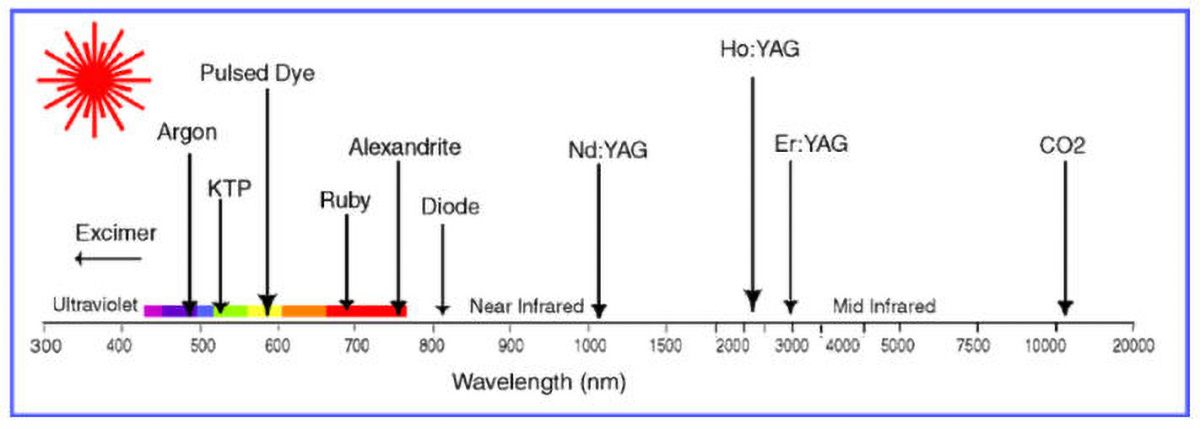
We currently develop over 10 new products per month and optimize them for various wavelengths used in aesthetic laser devices, such as 532nm, 808nm, 1064nm (Nd:YAG), 755nm (Alexandrite), 1470nm, 1927nm, 2940nm (Thulium), and CO2 laser (10600nm).
Substrate Material Selection
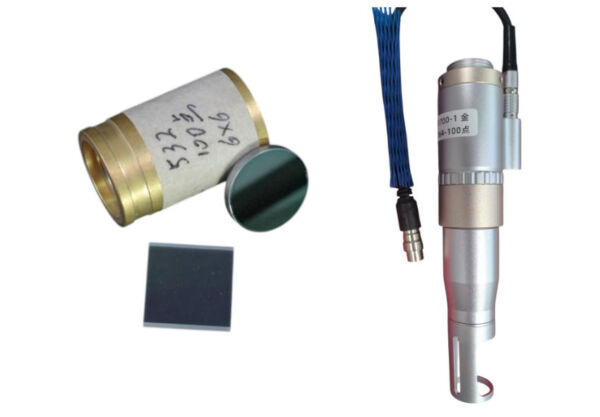
In these high-power lasers, our substrate materials are selected based on the laser wavelength, using either fused quartz or silicon for manufacturing. Fused quartz has a transmission range of 200nm to 2500nm, covering the commonly used wavelength bands for medical aesthetic lasers from ultraviolet to near-infrared. The substrate itself has low absorption and low scattering properties, reducing energy loss, Additionally, it has an extremely low coefficient of thermal expansion, high hardness, and excellent chemical stability, performing well under nanosecond, picosecond, or femtosecond lasers. It can withstand high-power pulses, enhancing treatment safety and comfort while ensuring high transmittance and resistance to laser ablation.
In medical aesthetic laser systems, silicon primarily excels in the infrared wavelength range. It exhibits extremely high infrared transmittance in the 1.2–8 μm range, typically around 60%, and when combined with an infrared anti-reflective coating, it is highly suitable for the near-infrared to mid-infrared wavelength bands of 1550 nm, 2940 nm, and 10600 nm. Compared to fused quartz, silicon has excellent thermal conductivity and a higher laser damage threshold. It can dissipate heat quickly, making it highly suitable for high-power infrared lasers. Additionally, silicon’s high material hardness and chemical stability ensure a long service life for components.
Manufacturing Capabilities and Customization Services We offer
Our company is currently highly proficient in the manufacturing of medical aesthetics micro-lens arrays and diffractive optical elements, and we are capable of undertaking the following:
- Customization of micro-array lenses and diffractive optical elements within the range of 200nm to 20 microns
- Minimum processing size of 3mm, with a maximum processing size of 4-6 inches
- Minimum thickness of 0.3mm, with a common thickness of 1mm.
- Array sizes ranging from 5×5, 7×7 to 33×33 points
Design and Implementation Process
In addition to standard inventory products, we can also provide optical design and customization based on customer application requirements:
Such as: laser wavelength, spot size, incident angle, matched power, diffraction order, period, aperture, spacing, fill factor, arrangement method, laser damage threshold, optical efficiency, etc.
Customers provide requirements, we perform optical design, and use photolithography masks as templates for production and implementation projects.