Slanted Gratings
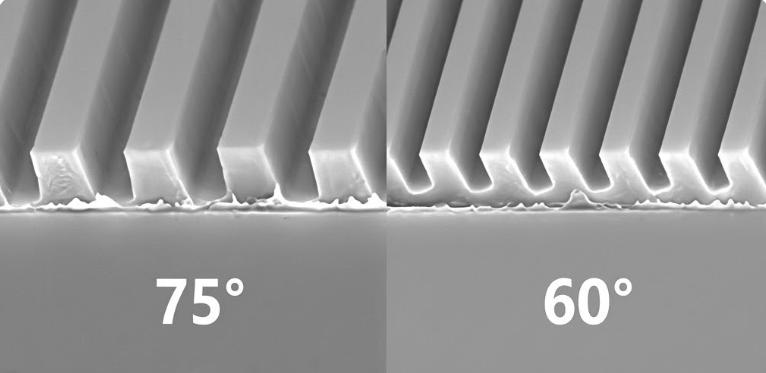
Coligh manufactures and custom slanted gratings (Slanted SRG) with slant angles from 40°–90°, groove densities of 300–1800 lines/mm, and line widths of 100–500 nm. Contact us for more detail.
Slanted Gratings Description
Slanted gratings are also known as tilted diffraction gratings. Slanted gratings are characterized by asymmetrical grooves, with the groove lines or grating vectors oriented at a specific angle relative to the surface normal. Coligh manufactures and customizes slanted gratings, which play a significant role in the fields of augmented reality (AR), optical communications, and spectroscopic analysis.
Slanted Gratings Key Features:
Slanted Surface Relief Grating exhibit the following key features:
- Unlike symmetrical rectangular gratings, tilted gratings are asymmetrical from left to right; when light is incident at a specific angle, it produces symmetrical diffraction
- Because the grooves are inclined, tilted gratings better satisfy the Bragg condition. Under specific polarization states, diffraction efficiency can be optimized by adjusting the tilt angle, duty cycle, and grating depth, achieving diffraction efficiencies of over 90%—higher than those of conventional binary gratings.
- Tilted gratings are highly sensitive to the angle of incidence, allowing for optical coupling within a specific angular range and suppressing stray light.
Coligh’s Slanted Surface Relief Grating Core Advantage
We are currently able to customize extremely large titled angle and high efficiency slanted gratings, ranging from 40 to 90 degrees, which determines the field of view (FOV) and brightness uniformity.
We employ nanometer-level depth control to ensure uniform groove depth, with a uniformity error of less than 3%, thereby guaranteeing that there are no noticeable color differences or brightness fluctuations across large-area waveguide plates.
Currently, we can produce tilted gratings up to 8 inches in size and achieve consistency across large areas.
We support complex groove designs, such as varying pitch and tilt angles, and can implement structures ranging from single-layer tilts to multi-layer composite structures based on the customer’s optical simulation models.
Custom High Efficiency Slanted Grating Fabrication Capability
| Parameter | Value |
|---|---|
| Substrate | Quartz / Glass / Silicon |
| Maximum Size | 8 in. |
| Maximum Thickness | 20 mm |
| Groove Density | 300 – 1800 lines/mm |
| Line Width | 100 – 500 nm |
| Groove Depth | ≤ 500 nm |
| Slant Angle | 40° – 90° |
| Coating Option | Al coating |
| Surface Figure Accuracy | λ/10 |
| Surface Finish | 20-10 / 40-20 / 60-40 |
Tilted Diffraction Gratings Applications
- AR
AR glasses require the efficient coupling of light from a microdisplay into a transparent waveguide, where it is transmitted and then coupled out to the human eye, while maintaining a clear view of the external environment. Traditional geometric optical solutions are bulky and have limited fields of view; In contrast, planar tilted gratings—as the core coupling/decoupling elements of diffractive waveguides—can achieve a wide field of view, high optical efficiency, and mass-producibility with a thickness of less than a millimeter, making them key to realizing consumer-grade AR glasses. - Chip-to-Fiber Coupling
In data center optical interconnects, high-performance computing, and co-packaged optics (CPO), light from optical fibers must be efficiently coupled into silicon photonics chips. Traditional vertical grating couplers suffer from polarization sensitivity, low coupling efficiency (approximately 50%), and narrow bandwidth. By introducing angular freedom, planar tilted gratings enable high-efficiency, polarization-independent, and broadband optical coupling. - Spectrometers
Traditional miniature spectrometers rely on planar gratings combined with imaging optics, resulting in large size, complex alignment, and high cost. Applications such as environmental monitoring, wearable health devices, and industrial process control require ultra-compact, low-cost solutions capable of acquiring the full spectrum in a single measurement. By directly integrating a planar tilted grating with a detector array, full-spectrum analysis can be achieved with a single exposure.