
Beam Shaping and Filtering Optics for Aesthetic Treatment
Introduction: Optics in Aesthetic Treatment
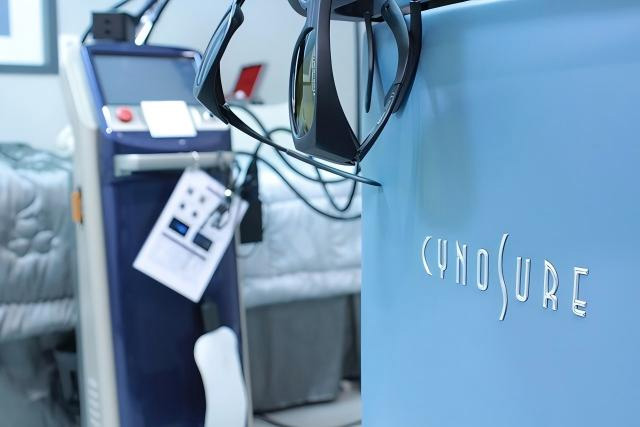
Light is the core component of aesthetic medical treatment devices, and whether it is meticulously designed and strictly controlled determines the success of such equipment. Within aesthetic medical treatment systems, the primary light sources are intense pulsed light (IPL), lasers, and near-infrared light. The spatial, spectral, and energy distribution of light collectively determine the therapeutic efficacy of these devices.
Unoptimized light output often suffers from uneven energy distribution, excessive energy in non-targeted wavelengths, and excessive thermal load that damages the treatment area, thereby compromising treatment safety. Therefore, the optical system serves as the core energy regulation system within aesthetic devices, playing a crucial role in their functionality.
Optical Challenges in Aesthetic Devices
Medical devices directly interact with human skin and tissue during treatment, which demands exceptionally high standards for safety and reproducibility. This places stricter requirements on the optical systems of medical equipment.
The challenges primarily manifest in the following aspects:
- Different treatment procedures require distinct wavelength ranges, necessitating precise and stringent spectral control of optical components.
- Under high-energy-density laser output, localized energy hotspots can compromise treatment comfort and safety.
- In aesthetic medical devices, prolonged operation is common. The operating environment and treatment objectives necessitate optical components capable of withstanding significant environmental variations.
These challenges dictate that aesthetic medical devices cannot rely on a single optical component. Instead, optimization must be approached from a holistic perspective.
Filters for Wavelength Selection and Safety
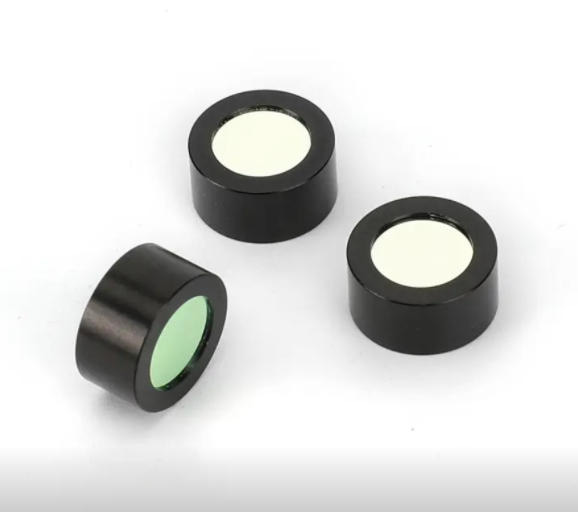
Optical filters play a core functional role in medical aesthetic treatment systems. They enable precise spectral control, selectively transmitting target wavelengths while blocking unwanted harmful ones—such as filtering out ultraviolet and blue light wavelengths—to prevent epidermal burns and concentrate energy for therapeutic purposes.
In aesthetic devices, long-pass filters commonly used for IPL treatments include wavelengths such as 430nm, 510nm, 530nm, 560nm, 610nm, 640nm, 690nm, and 750nm. Additionally, various bandpass filters with distinct wavelengths are employed in aesthetic devices. Their primary functions include treating superficial pigmentation, skin rejuvenation, vascular conditions, hair removal, or deep skin tightening.
Microlens Arrays for Beam Homogenization
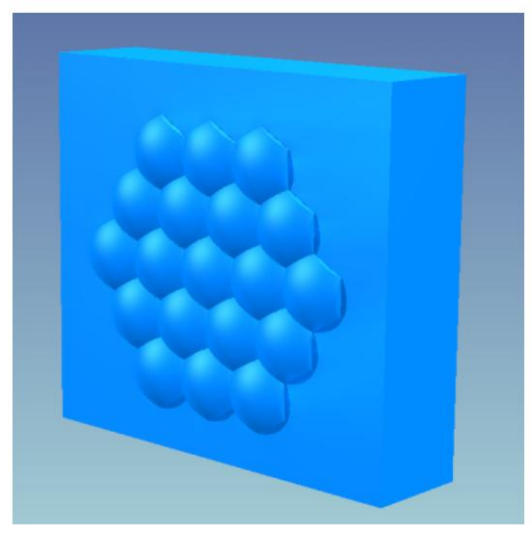
In IPL/pulsed laser/semiconductor laser aesthetic medical systems, the original spot pattern typically exhibits a central hot spot with a cold periphery, forming a distinct cap-shaped distribution with pronounced Gaussian characteristics. Microarray lenses serve to homogenize the spot pattern within aesthetic medical devices. They address issues caused by uneven spots, such as epidermal burns, inconsistent treatment efficacy, and clinical unpredictability.
In aesthetic devices, microarray lenses can divide a single beam into N×N sub-spots.
- Refractive microarray lenses are compatible with over 90% of aesthetic devices.
- Diffractive microarray lenses can also be used in aesthetic equipment.
- Microarray lenses integrated onto fiber end-faces can be directly applied to MLA fiber output ports.
Primary applications of microarray lenses in aesthetic devices include:
- Wavelengths of 5000-1200nm
- 755/805/940/1064nm wavelengths for semiconductor laser hair removal
- 1064nm/1320nm/1550nm MLA for skin tightening
In summary, microarray lenses enhance spot uniformity and improve overall system energy efficiency by subdividing and recombining incident light.
Diffractive Optical Elements for Advanced Beam Shaping
Diffractive optical elements (DOE) function within medical aesthetic devices to shape light, such as modifying beam morphology, redistributing light, and multiplying light points.
- Point-type beam splitter DOEs constitute the largest category of medical aesthetic DOEs, accounting for the highest proportion. Diffractive beam splitters divide a single laser beam into a regular array of small spots for non-ablative fractional laser treatments.
- Top hat beam shapers reshape Gaussian spots into nearly flat-topped beams, typically used with single-wavelength lasers.
- Ring-shaped or doughnut-shaped spots can be employed for epidermal protection or specialized vascular treatments.
Infrared Optics for Deep Tissue Treatment
In aesthetic medical devices, infrared optical components also play a critical role.
- For instance, infrared lenses are typically made from fused quartz, CaF₂, ZnSe, sapphire, etc. (Primarily used for laser focusing, spot imaging, and array imaging)
- Infrared Windows: Sapphire windows, quartz windows (typically positioned at the very front of handpieces)
- Infrared Filters: Narrowband infrared filters, long-pass infrared filters, broadband infrared filters (primarily function to suppress stray light)
- Infrared Microarray Lenses: 2940nm, 1550nm
- Infrared GOE: 1064nm/1320nm/1550nm/10.6μm dot array beam splitter DOE, flat-top shaping DOE
These infrared optical components ensure high transmittance while withstanding thermal stress from long-term high-power operation. Material selection and precision manufacturing guarantee the system’s overall service life.
Coligh’s Next-Generation Aesthetic Solutions
Coligh is a manufacturer of optical filters, infrared optics, microlens arrays, and DOEs. We understand that as medical aesthetic equipment evolves toward higher power, greater precision, and multifunctionality, we will continue to provide forward-looking comprehensive optical solutions to drive the advancement and innovation of medical aesthetic treatment devices.