
Silicon Hexagonal Microlens Arrays
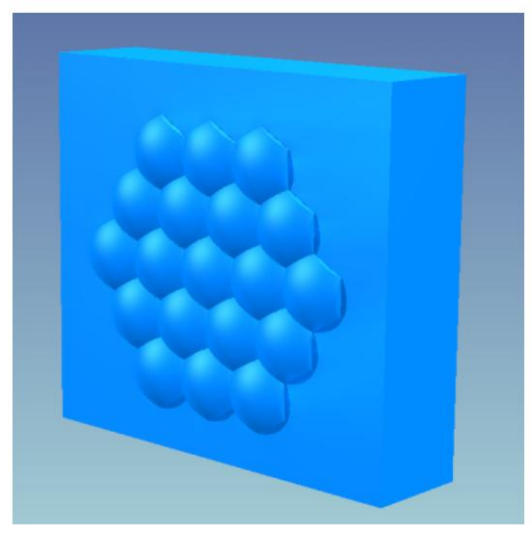
Coligh manufactures refractive microlens arrays with hexagonal apertures and hexagonal arrangement, using monocrystalline silicon as the substrate. It is suitable for applications such as infrared imaging, laser beam shaping, and fiber coupling.
Its key features below:
- The lens features a hexagonal aperture, which offers more uniform beam distribution and higher fill factor compared to square or circular apertures.
- The hexagonal array layout ensures even light field distribution and enhances spatial resolution, making it especially suitable for homogenized illumination.
- Monocrystalline silicon is used as the substrate material, known for its high purity, hardness, and low thermal expansion, making it ideal for infrared applications.
- Lens apertures range from 120 µm to 1000 µm, supporting multi-channel integrated designs.
- Focal length ranges from 0.55 to 40 mm, accommodating various working distances.
- Surface coating is optimized for near-infrared at 1550 nm, a typical wavelength for telecom and sensing applications.
Standard Silicon Hexagonal Microlens Arrays Series:
| Product No. | Pitch | EFFL. | Dim. | Thick | ROC | N.A. | Wavelength |
|---|---|---|---|---|---|---|---|
| MRLS(HH)-127 | 127.0μm | 55,00 | 10×10 | 1 | -1.362,00 | 115,00 | 1.55μm |
| MRLS(HH)-250 | 250.0μm | 1,00 | 10×10 | 1 | -2.478,00 | 125,00 | 1.55μm |
| MRLS(HH)-300 | 300.0μm | 1,00 | 10×10 | 1 | -2.478,00 | 15,00 | 1.55μm |
| MRLS(HH)-500 | 500.0μm | 2,00 | 10×10 | 1 | -4.955,00 | 125,00 | 1.55μm |
| MRLS(HH)-600 | 600.0μm | 5,00 | 10×10 | 1 | -12.388,00 | 6,00 | 1.55μm |
| MRLS(HH)-A00 | 1000.0μm | 40,00 | 12×12 | 2 | -17.768,00 | 13,00 | 1.55μm |
Micro Lens Arrays Manufacturer Core Capability
| Capability | Description |
|---|---|
| Design & Simulation | We perform parameter design and simulation using Zemax, LightTools, and COMSOL. |
| Core Fabrication Processes | We support microstructure fabrication via deep UV lithography and molding processes. |
| Material Engineering | We can process materials such as monocrystalline silicon, fused silica, float glass, PMMA, and metals. |
| Lens Shape Customization | We support fabrication of high-order aspheric and freeform surfaces. |
| Extreme Machining Capability | We can produce lenses with small curvature radius and apertures ranging from 10 μm to 1500 μm. |
Microlens Arrays Customized Solutions and System Integration Guidance
- Conduct initial design input based on your optical requirements, application needs, and operating environment.
- Perform multiphysics simulation and modeling using tools such as Zemax, LightTools, and COMSOL.
- Finalize and optimize key parameters such as lens aperture, focal length, array layout, and beam shape.
- Adapt to your system interface based on the target module, and provide output in forms such as wafer-level bare chips, framed packages, metal mounts, glass carriers, PCB integration, or ceramic substrates.
Silicon Hexagonal Microlens Arrays Application:
- Infrared Imaging Systems
Traditional square arrays have a low fill factor. Integrating microlens arrays on the surface of infrared detectors, the hexagonal honeycomb structure enables focusing and beam alignment, effectively covering more active pixels.
- Laser Beam Shaping
Multimode lasers or VCSEL arrays often suffer from uneven beam profiles and low edge energy. Hexagonally arranged microlens arrays can homogenize the laser beam and can be used in combination with microlens posts, DOE, etc.
- Fiber Coupling
Multi-channel fiber systems require high-precision beam focusing and collimation. Aligning the microlens array with multi-core fiber interfaces or fiber arrays enables efficient one-to-many or many-to-many coupling.