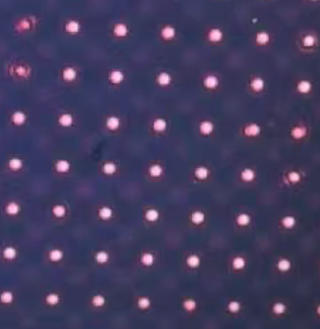
266nm Diffractive Beam Splitter DOE For PCB Laser Drilling Glass Substrate
Coligh manufactures and custom 266nm Diffractive Beam Splitter DOE For PCB Laser Drilling Glass Substrate applications. We also specialized in 355nm flat top shaping DOE for PCB laser drilling CCL.
266nm Beam Splitter DOE For PCB Laser Drilling Glass Substrate Product Discription
The 266nm diffractive beam splitter (DOE) is a deep UV diffractive optical element specifically designed for PCB laser drilling and micro-hole processing on glass substrates. The 266nm DUV laser beam splitter and DOE are core technologies for sub micron micro-hole laser processing on glass substrates and HDI boards. By splitting a single laser beam into multiple beams with uniform spot sizes, it enables the processing of multi-hole arrays in a single exposure, thereby improving processing efficiency and hole diameter consistency. Coligh offers both standard and custom 266nm beam splitter DOEs for micro-hole processing in high-precision HDI and glass substrates, making them an ideal choice for next-generation advanced packaging, PCB manufacturing, and design. In addition to producing 266nm DOEs for PCB laser drilling, we also manufacture 355nm fat top beam shaping DOEs that convert Gaussian spots into top-hat spots, resulting in more uniform and rounded micro-hole diameters.
266nm Beam Splitter DOE For PCB Laser Drilling Glass Substrate Product Features
- Our 266 nm beam splitter DOE is specifically optimized for the deep ultraviolet 266 nm wavelength. When paired with a 266 nm narrow-pulse laser, the DOE enables a smaller heat-affected zone and higher edge quality, resulting in more uniform and rounded holes.
- We can customize 1×N or N×M beam arrays based on the customer’s specific application requirements, allowing multiple holes to be drilled simultaneously with a single pulse and improving production efficiency.
- Our DOE beam splitter offers high uniformity, ensuring consistent intensity and height across all sub-beams and eliminating size deviations between holes.
- We utilize high-quality UV fused silica substrates for micro- and nano-processing, which remain stable even under high peak powers of nanosecond and picosecond UV lasers.
- This diffractive laser beam splitter is specifically designed for TGV (Through-Glaze Via) drilling on glass substrates and is also suitable for HDI (High-Density Interconnect) microvia formation, enabling the processing of large numbers of blind and buried vias on PCB glass substrates.
Why Choose Coligh For Quartz/Glass Micro Machining Project
- We offer fast, customized delivery services, with everything from array layouts to dimensions fully customizable. We also possess exceptional design capabilities. Our lead times are flexible, typically ranging from 4 to 6 weeks.
- Leveraging our proven micro- and nano-manufacturing processes, we maintain a high level of consistency between batches, ensuring stable production line operations.
- We support everything from prototyping to mass production, with no minimum order quantity for samples. We welcome your inquiries.
Coligh 266nm Beam Shaper DOE For PCB Laser Drilling
| Custom Items | Custom Capability |
|---|---|
| Operating Wavelength | UV 266nm for high-precision PCB and glass substrate laser drilling |
| Beam Split Array | 1×N or N*M |
| Sub-beam Uniformity | ≤ ±5% (typical), can be optimized to ±2% |
| Diffraction Efficiency | ≥ 80% |
| Zero-order Leakage | ≤ 1% |
| Laser Damage Threshold | 20J/cm² @ 266nm |
| Substrate Material | UV-grade fused silica (quartz) |
| Anti-Reflection Coating | Dual-sided 266 nm AR, R < 0.5% |
| Micro-hole Capability | Supports micro-hole arrays (≥5 μm) |
266nm Diffractive Beam Splitter DOE Application
- TGV Laser Drilling
Glass substrates serve as the core carriers in advanced semiconductor packaging, requiring the fabrication of tens—or even hundreds—of thousands of micro-vias on their surfaces. Relying on traditional single-beam processing methods is both time-consuming and labor-intensive. Furthermore, the quality of the TGV (Through-Glass Via) sidewalls directly determines the uniformity of subsequent copper filling and the overall electrical performance. When a Diffractive Optical Element (DOE) is introduced into a 266nm picosecond or nanosecond laser beam path, it splits the beam to form 1×N or M×N arrays. This enables array-based, sequential drilling across the glass substrate while simultaneously ensuring precise control over the energy uniformity of each individual sub-beam. Consequently, throughput per unit of time is significantly increased, and processing costs are reduced. - HDI Micro-via Formation
When fabricating high-density blind vias and buried vias on glass-based PCBs, extremely small via diameters are required. Single-beam processing is inherently slow and suffers from poor consistency. Moreover, glass substrates are characterized by high material brittleness and extreme sensitivity to thermal accumulation, making them prone to developing thermally induced cracks. The use of a DOE accelerates the processing speed, allowing the entire operation to be completed within a very short timeframe, thereby effectively preventing thermal accumulation.