355nm DOE Beam Splitting & Shaping Solutions for PCB and CCL Micro-machining
Coligh manufactures and custom 355nm UV Diffractive Beam Splitter and beam shaping DOEs for TGV glass drilling optical module and High-speed CCL micro-via drilling optics.
355nm DOE Beam Splitting & Shaping Solutions for CCL Drilling Product Discription
The 355 nm UV laser is characterized by high photon energy and excellent material absorption. Our company has developed and manufactures a 355 nm DOE (diffractive optical element) specifically designed for UV laser processing of PCBs and CCLs. This diffractive optical element includes Diffractive Beam Splitter for UV Laser and 355nm Top-hat beam shaping converts the laser beam into a dot-matrix or flat-top beam profile. It is suitable for micro-blind hole drilling in high-density interconnect boards and for punching and cutting copper-clad laminates. This solution addresses issues in CCL cutting caused by energy non-uniformity—such as overburning, slow processing speeds in single-point serial operations, and insufficient depth of focus limiting multi-layer processing. By precisely modulating the phase across a wide area through the micro-nano structures on our DOE surface, we maintain a constant laser output while converting it into the point- or block-shaped energy patterns required for the machining process.
355nm DOE Beam Splitting & Shaping Solutions for CCL Drilling Product Features
- Our 355nm UV DOE enables high-precision micro-hole processing, capable of fabricating micro-holes with diameters of 5µm or larger. By combining 355nm UV light with DOE beam shaping technology, we ensure exceptional uniformity in hole diameters.
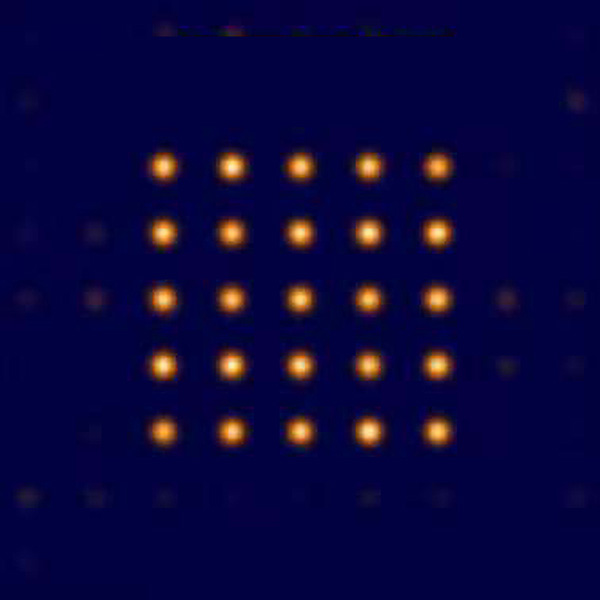
- Utilizing a 355nm UV diffractive beam splitter, a single incident beam can be split into multiple laser beams—forming a 1xN beam splitter with homogenized spots—thereby enabling the simultaneous processing of multiple micro-holes and significantly boosting PCB production throughput.
- With our 355nm Top-hat Beam Shaping DOE, a Gaussian beam profile can be reshaped into a square or circular flat-top spot, featuring an energy distribution uniformity exceeding 80%. This allows for precise control over the heat-affected zone (HAZ) on Copper Clad Laminates (CCL), while simultaneously ensuring clean and crisp cut edges.
- We employ high-purity UV-grade fused silica, coupled with a 355nm double-sided anti-reflective coating (reflectance <0.5%). This design ensures that our 355nm DOE maintains a high damage threshold, thereby minimizing stray light and energy loss to the greatest extent possible.
Why Choose Coligh For Your Laser Micro-machining Optics Project
- We determine the direction of the DOE design based on the client’s specific process parameters, providing fully customized consulting and design services.
- Our custom design cycle is rapid; prototype components can be delivered within 4 to 6 weeks. Furthermore, we collaborate with processing platforms to conduct process testing and refine the design based on client feedback.
- We employ high-precision, semiconductor-grade lithography and etching processes to ensure consistency across mass production batches.
Coligh 355nm Beam Splitter DOE For PCB Laser CCL Drilling Custom Capability
| Custom Parameter | Options |
|---|---|
| Operating Wavelength | 355 nm, 532nm, 1064nm |
| Beam Split Array | 1×2 , 2×2 , 3×3 , 5×5 , 1×N , N*M, Custom |
| Beam Shaping Type | Circular , Square , Elliptical or Custom |
| Sub-beam Uniformity | ≤ ±5% (typical), can be optimized to ±2% |
| Diffraction Efficiency | ≥ 80% |
| Zero-order Leakage | ≤ 1% |
| Laser Damage Threshold | 20 J/cm² @ 355nm |
| Substrate Material | UV-grade fused silica |
| Anti-Reflection Coating | Dual-sided 355nm AR, R < 0.5% |
| Micro-hole Diameter / Specification | >=5μm |
| Substrate Type | CCL / PCB/ Glass |
| Custom Notes | Text input |
355nm Laser Micro-machining Optics Splitter and Shaper Application
-
Optical Systems for Micro-hole Drilling in Glass Substrates
Glass substrates serve as the core carriers for advanced packaging, display panels, and microfluidic devices. Traditional mechanical drilling methods are highly prone to causing glass fragmentation and edge chipping, and are incapable of fabricating through-holes with diameters smaller than 100 μm. Conventional single-spot laser drilling is too slow due to its point-by-point processing nature; furthermore, drilling with a Gaussian beam results in significant hole taper and rough hole walls. Consequently, specialized optical systems for glass substrate micro-hole drilling—along with corresponding Through-Glass Via (TGV) laser solutions—are required to simultaneously meet the demands for high precision, damage-free processing, and high throughput. We employ DOE-based multi-spot beam-splitting technology to divide a single UV laser beam into an array of dozens of spots, enabling the simultaneous fabrication of multiple micro-through-holes on the glass substrate with a single laser pulse. When integrated with high-precision galvanometer scanners, this system can rapidly create tens of thousands of precisely positioned TGVs across the entire surface of a glass substrate.
-
Laser Drilling on CCL using DOE
In the laser drilling process for Copper-Clad Laminates (CCL) used in High-Density Interconnect (HDI) boards and IC carrier substrates, a single focused laser spot must sequentially process hundreds of thousands—or even millions—of micro-blind holes. This serial processing mode severely limits production line throughput and constitutes a significant bottleneck within the overall PCB manufacturing workflow. By utilizing a multi-spot laser beam-splitting DOE—specifically, our proprietary DOE Multi-spot diffractive beam-splitting element—we can transform the single 355 nm UV laser beam emitted by the source into an M×N matrix of discrete, energy-uniform spots at the focal plane. This enables parallel laser drilling operations on CCL substrates using DOE technology.
-
Parallel Laser Drilling
For advanced packaging carrier substrates—such as those used in Fan-Out, 2.5D, and 3D packaging architectures—critical feature sizes are continuously shrinking, and the density of interconnect vias is rising exponentially. Furthermore, processing must be performed across a variety of heterogeneous materials, including organic dielectrics, glass, and silicon. Conventional optical systems are fundamentally incapable of meeting the demands of such high-density, multi-material parallel processing. Therefore, it is essential to leverage Diffractive Optical Elements (DOEs) to facilitate parallel laser drilling, while simultaneously enabling the precise manipulation of the UV laser beam to ensure compatibility with advanced packaging processes. Our parallel laser drilling diffractive optical elements enable the flexible modulation of a 355nm laser into any desired dot array pattern—such as square, hexagonal, or aperiodic arrangements—perfectly matching the design layouts of various packaging substrates.