
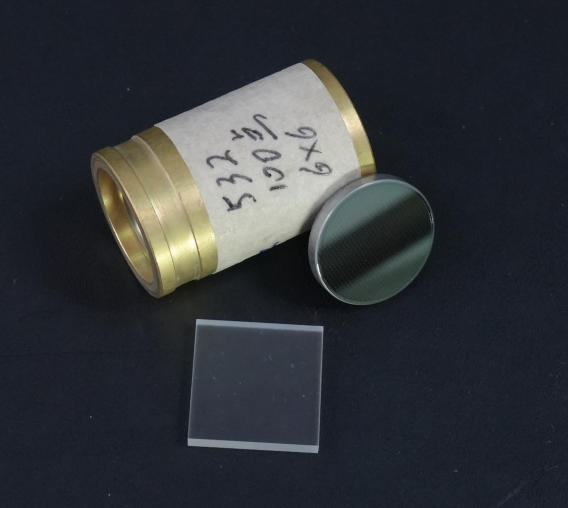
2D Diffractive Beam Splitter Grating
Coligh specializes in the production of diffractive beam-splitting elements, and we have produced a wide range of 2D Diffractive Beam Splitting Gratings, with the highest array of dots that can reach 33X33 over any area, and with optimal diffraction efficiency of 80%-90%. We have a wide range of 2D diffraction beamsplitter gratings with a maximum dot pattern of 33×33 over any area, and an optimum diffraction efficiency of 80%-90%.
2D Diffractive Beam Splitter Grating Description
2D Diffractive Beam Splitting Gratings are optical elements with bi-directional periodic micro-nano structures machined on the substrate surface, which split a single beam of incident light into multiple beams in multiple directions through the diffraction effect, and can be simultaneously split in both X and Y.
2D Diffractive Beam Splitter Grating Description Product features:
- Plane matrix segment beam splitting, support a variety of dot matrix format, up to 33 * 33 dot matrix support
- Working wavelength 532nm, 755nm, 1064nm, 10.6μm, covering a number of commonly used laser wavelengths, and its suitability for medical, cosmetic, industrial and other lasers.
- Diffraction angle ranges from 4.77° to 11.91°, can support small angle dense array and large angle sparse array.
- Depending on customer applications and support, fused silica, silicon and germanium can be used as the material substrate for processing, applicable to the spectral range from the ultraviolet to the infrared.
- The working surface area ranges from small to large sizes, and can be adapted to a wide range of scenarios of light spots.
- The device form factor ranges from small to large, which can be applied to long-distance projection and high-intensity laser.
- All 2D diffraction beam splitter gratings are able to maintain <=5% spot energy uniformity, ensuring highly consistent output arrays.
2D Diffractive Beam Splitter Grating Product Series
| Product No. | Spot | WL | Diff. Angle | Mat. | Area. | W.D. | Dim. | Best Uni. |
|---|---|---|---|---|---|---|---|---|
| MBSQ2-DC05-1-20C | 5×5 | 0.532μm | 11.73° | Silica | 10.3mm×10.3mm | 50.0mm | Φ17.4mm×27.0mm | 4,00 |
| MBSQ2-DC05-2-20C | 5×5 | 0.532μm | 9.38° | Silica | 8.2mm×8.2mm | 50.0mm | Φ17.4mm×27.0mm | 4,00 |
| MBSQ2-DC05-3-20N | 5×5 | 0.532μm | 5.86° | Silica | 5. 1mm×5. 1mm | 50.0mm | Φ17.4mm×27.0mm | 4,00 |
| MBSQ2-DC07-1-20C | 7×7 | 0.532μm | 11.42° | Silica | 10.0mm×10.0mm | 50.0mm | Φ17.4mm×27.0mm | 4,00 |
| MBSQ2-DC07-2-20C | 7×7 | 0.532μm | 8.02° | Silica | 7.0mm×7.0mm | 50.0mm | Φ17.4mm×27.0mm | 4,00 |
| *MBSQ2-DC09-2-21C | 9×9 | 0.532μm | 5.71° | Silica | 10.0mm×10.0mm | 100.0mm | Φ18.0mm×2.0mm | 1,00 |
| MBSQ2-DC10-1-20C | 10×10 | 0.532μm | 11.91° | Silica | 10.4mm×10.4mm | 50.0mm | Φ17.4mm×27.0mm | 4,00 |
| MBSQ2-DC10-2-20C | 10×10 | 0.532μm | 8.72° | Silica | 7.6mm×7.6mm | 50.0mm | Φ17.4mm×27.0mm | 4,00 |
| MBSQ2-DC10-3-20C | 10×10 | 0.532μm | 6.87° | Silica | 6.0mm×6.0mm | 50.0mm | Φ17.4mm×27.0mm | 4,00 |
| MBSQ2-DE10-1-20C | 10×10 | 0.755μm | 11.42° | Silica | 10.0mm×10.0mm | 50.0mm | Φ17.4mm×27.0mm | 4,00 |
| MBSQ2-DG05-3-20C | 5×5 | 1.064μm | 11.45° | Silica | 10.0mm×10.0mm | 50.0mm | Φ17.4mm×27.0mm | 5,00 |
| MBSQ2-DG07-1-20C | 7×7 | 1.064μm | 11.42° | Silica | 10.0mm×10.0mm | 50.0mm | Φ17.4mm×27.0mm | 4,00 |
| MBSQ2-DG07-2-20C | 7×7 | 1.064μm | 8.02° | Silica | 7.0mm×7.0mm | 50.0mm | Φ17.4mm×27.0mm | 45,00 |
| MBSQ2-DG07-4-20C | 7×7 | 1.064μm | 5.7248° | Silica | 10.0mm×10.0mm | 100.0mm | Φ17.4mm×27.0mm | 45,00 |
| *MBSQ2-DG08-1-21C | 8×8 | 1.064μm | 4.77° | Silica | 5.0mm×5.0mm | 60.0mm | Φ25.4mm×2.0mm | 4,00 |
| MBSQ2-DG10-1-20C | 10×10 | 1.064μm | 11.87° | Silica | 10.4mm×10.4mm | 50.0mm | Φ17.4mm×27.0mm | 4,00 |
| MBSQ2-DG10-2-20C | 10×10 | 1.064μm | 8.72° | Silica | 7.6mm×7.6mm | 50.0mm | Φ17.4mm×27.0mm | 4,00 |
| MBSQ2-DG10-3-20C | 10×10 | 1.064μm | 6.87° | Silica | 6.0mm×6.0mm | 50.0mm | Φ17.4mm×27.0mm | 4,00 |
| *MBSG2-DK09-1-21C | 9×9 | 10.600μm | 11.42° | Ge | 10.0mm×10.0mm | 50.0mm | Φ15.0mm×2.0mm | 45,00 |
Coligh Lithography Custom 2D Diffraction Beamsplitter Gratings Capability
| Custom Item | Specification |
|---|---|
| Fabrication Process | Lithography + Etching |
| Wavelength Range | 200 nm – 20 µm |
| Incident Angle | Customizable as per application |
| Beam Array Pattern | Up to 33×33 dots |
| Diffraction Efficiency | ≥70%, up to 80%–90% |
| Materials | Fused Silica, Silicon, Germanium |
| Pitch | 10 – 1500 µm |
| Size Range | Min 1.5 mm, Max 4–6 inches |
| Surface Coating | AR Coating, Reflective Coating |
| Device Integration | Currently integrable with medical aesthetic systems |
Photolithography Process for 2D Dot Matrix Gratings Manufacturing
We use UV photolithography process to prepare 2D diffraction beam split grating by transferring the pattern to the substrate through the mask plate, and we get the high precision 2D diffraction structure through the design of the mask plate, exposure, etching, and inspection. Our advantages:
- Precise control of linewidth and period, allowing the design of high-order beam splitters
- Processing hundreds of devices on the same wafer with sizes up to 4-6 inches
- Support customized 2D dot matrix of arbitrary shape
- High diffraction efficiency, beam shaping stability
- With high-volume manufacturing capacity, more economical cost
- Support system integration with lasers, optical communication, medical cosmetology, 3D imaging, and other industries.
DOE Beam Splitter Grating Kit Integration:

For our customers in the medical aesthetics industry, we offer not only diffractive high-quality beam splitter gratings, but also beam splitter grating kit integration solutions: plug-and-play modules with integrated gratings, collimated structures and other products. Specialized in laser aesthetics, photorejuvenation and other applications.
2D Diffractive optical element Laser Dot Matrix Generator Application
- Medical cosmetology industry
In the medical cosmetology industry, 2D DOE beam splitter can be used in skin laser resurfacing, fractional laser treatment, picosecond and nanosecond devices. 2D Diffractive grating can split a single laser beam into hundreds of uniform spots for large area synchronized treatment. - Laser Fractional
In the laser fractional laser industry, the array beam splitter can be used for PCB laser punching, ITO punching and other scenarios, the 2D grating can split the laser energy into 2D arrays, multiple spots can be processed at the same time. - 3D Structural Imaging
In the 3D structural imaging industry, 2D grating can be used in structured light 3D camera, ToF and other systems, which disperses the laser energy into a regular array of dots, and then transmits it to the surface of the object to do three-dimensional depth measurement.