Aluminum Coated Reflective Blazed Gratings
Coligh manufactures and custom Aluminum Coated Reflective Blazed Gratings for 300-1500nm with different 0°-40° blazed angles. Contact us for more detail.
Aluminum Coated Reflective Blazed Gratings Description
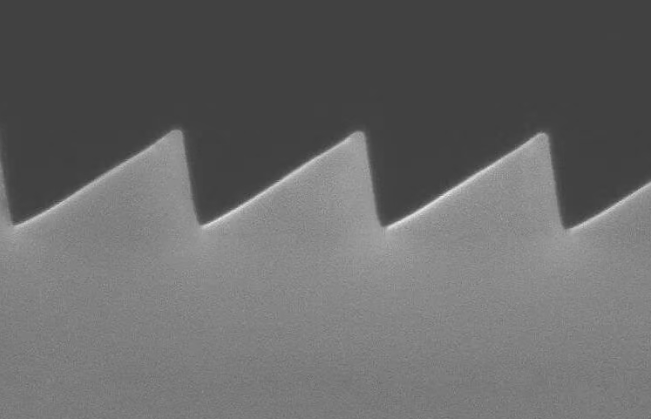
A blazed grating is a special type of grating with a sawtooth or stepped groove cross-section. Aluminum-coated reflective blazed gratings are a specific type of reflective diffraction grating that, by altering the inclination of the groove surface—that is, by setting a specific blazing angle on the grooves—causes the direction of reflected light at a specific wavelength to coincide with the direction of diffracted light, Most of the light energy is concentrated at a specific diffraction order, thereby achieving maximum diffraction efficiency for that specific wavelength. Coligh is a manufacturer of Aluminum Coated Reflective Blazed Gratings, and we offer custom blazed grating services. These products are widely used in fields such as aerospace and optical communications.
Aluminum Coated Reflective Blazed Gratings Features:
Conventional flat gratings disperse the incident light energy across multiple orders, resulting in relatively low energy utilization for each individual order. Unlike ordinary plane gratings, a diffractive grating reflects incident light at each tiny serrated surface, and all light reflected from these surfaces can interfere and superimpose in space, thereby concentrating the vast majority of the light energy onto this order.
- Consequently, diffractive gratings possess extremely high diffraction efficiency and can be used to detect weak signals in spectrometers.
- Additionally, by customizing the glint angle, they can be optimized for ultraviolet, visible, and infrared light.
- Furthermore, they offer an extremely high signal-to-noise ratio because the high diffraction efficiency concentrates energy on the main order, reducing stray light interference from other orders.
Coligh’s Aluminum Coated Reflective Blazed Gratings core Advantage
Coligh is a manufacturer of Aluminum Coated Reflective Blazed Gratings. We utilize high-precision engraving machines to ensure exceptional consistency in the groove profile and line straightness of master gratings. Our highly sophisticated and stable engraving process guarantees that the first and the thousandth gratings exhibit identical diffraction angles and wavefront distortion.
- We currently offer λ-1/10λ substrate profiles, which minimize stray light.
- For laser application customers, we provide aluminum coatings with high damage thresholds. The aluminum coating exhibits exceptional adhesion to the substrate, enabling it to withstand the impact of continuous-wave and pulsed lasers.
- We offer processing of ultra-large-aperture diffraction gratings up to 8 inches in diameter and can customize the diffraction angle according to the customer’s optical system.
- Currently, our company possesses multi-wavelength processing capabilities, covering the range from 300 nm to 1500 nm.
UV-VIS Reflective Diffraction Grating Custom Capability
| Parameter | Specification |
|---|---|
| Substrate Material | Quartz / Silicon / Optical Glass |
| Thickness | ≤ 20 mm |
| Groove Density | 300 – 1800 lines/mm |
| Grating Period | ≤ 550 nm (to be confirmed) |
| Groove Depth (Height) | ≤ 500 nm |
| Working Wavelength | 300 – 1500 nm |
| Blaze Angle | 2° – 40° |
| Coating | Aluminum (Al) |
| Surface Figure | λ / 10 |
| Surface Quality (optional) | e.g., 60/40 40/20 20/10 |
Aluminum Coated Reflective Blazed Gratings Applications
- Spectrophotometer
A spectrophotometer must disperse polychromatic light into monochromatic light while maintaining a high signal-to-noise ratio across a broad wavelength range (ultraviolet to near-infrared). The reflectance of an aluminum-coated diffraction grating remains stable and high within the 190–1850 nm range. The diffraction design concentrates energy onto the first-order diffraction, avoiding energy loss at the zero-order diffraction, thereby enhancing detection sensitivity. - Raman Spectrometer
Raman scattering signals are extremely weak. Therefore, the transmission or reflection efficiency of the spectrometer directly determines the signal-to-noise ratio. Aluminum-coated diffractive gratings offer diffraction efficiencies of over 70% in the visible to near-infrared range (commonly used Raman excitation wavelengths: 532, 633, and 785 nm). This enables stronger Raman signals at the same laser power, reducing the risk of sample damage or shortening measurement time. - Tunable Lasers
In dye lasers, titanium-sapphire lasers, or external-cavity semiconductor lasers, a high-efficiency, narrow-bandwidth wavelength-selective element is required to lock and tune the laser wavelength. Brilliant gratings feature high reflectivity (especially in orders other than the 0th) and narrow-linewidth feedback capabilities, and can withstand high laser power. They enable wide tuning ranges (e.g., 700–1000 nm for titanium-sapphire lasers) with high efficiency, reducing cavity losses.