395nm UV Shortpass Edge Filter
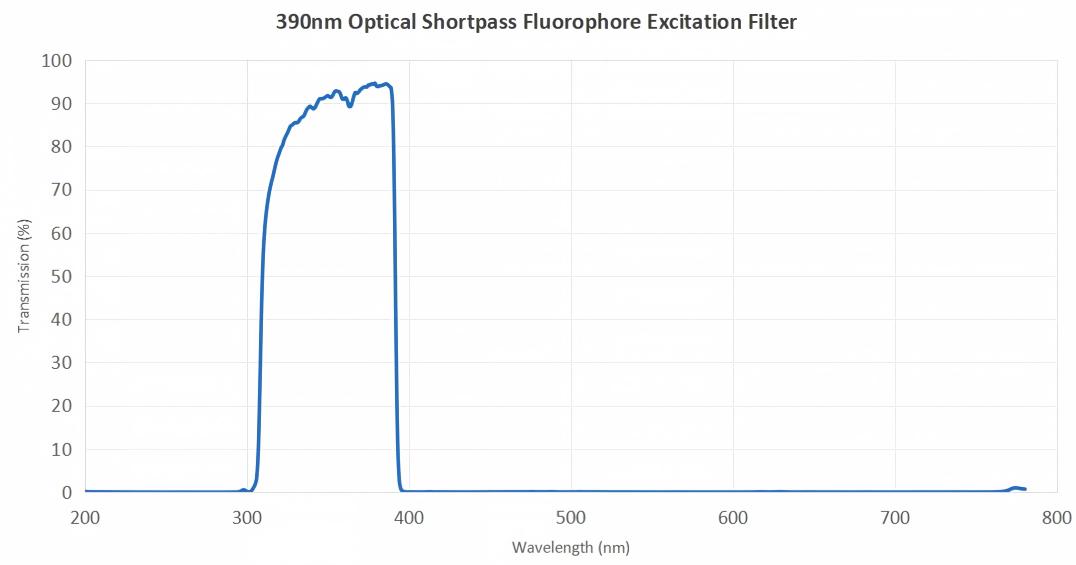
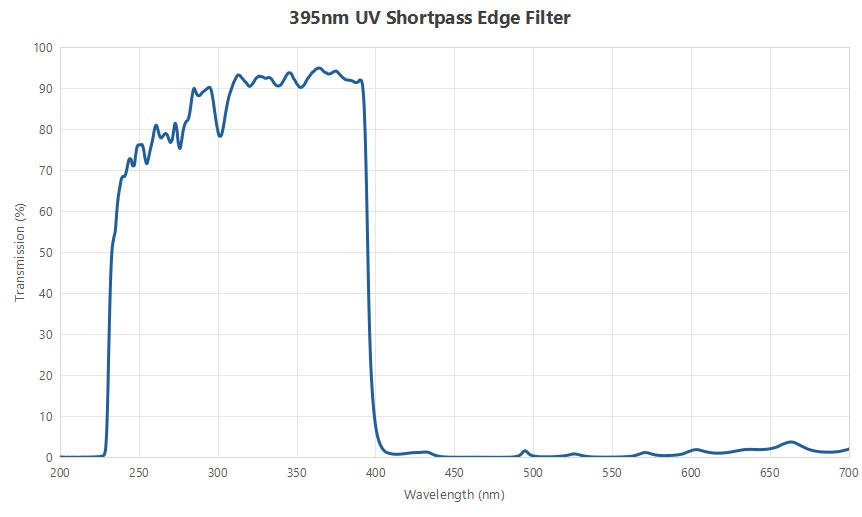
395nm UV Shortpass Edge Filter is an optical filter which cut off at 395nm and block 400-650nm visible light. Coligh customs and manufactures UV shortpass edge filters with various options.
395nm UV Shortpass Edge Filter Overviews
Coligh’s 395nm UV shortpass edge filter offers high transmission in the UV to near-UV range and an OD2 blocking depth across the 400–700nm spectrum. Utilizing a UV-grade fused silica substrate and a hard dielectric coating structure, the filter combines a high damage threshold, low autofluorescence, and long-term UV stability, making it suitable for applications such as UV curing, fluorescence excitation, anti-counterfeiting inspection, forensic imaging, and UV spectroscopy.
The Characteristic Of 395nm UV Shortpass Edge Filter
- The transition zone at 395 nm is less than 15 nm, enabling precise separation of UV/violet light from visible light and eliminating crosstalk at the cutoff wavelength.
- It covers key mercury lamp spectral lines (such as 254 nm, 313 nm, and 365 nm) as well as UV LED emissions at 365 nm and 385 nm, with an average passband transmittance exceeding 85%, thereby maximizing the retention of usable UV energy.
395nm UV Shortpass Edge Filter Technical Datasheet
- Cut off wavelength: 385+/-5nm
- Tave>85%@235-380nm
- Tave 1% @ 400-700nm
- Size stock avaiable: 80*80*1mm
Spectrum of 395nm UV Shortpass Edge Filter
Custom Capability Of UV Shortpass Edge Filter
| Item | Customization Capability |
|---|---|
| Operating Range | UV 200–400 nm |
| Cut-off Wavelength | 200 nm / 220 nm / 240 nm / 254 nm / 280 nm / 300 nm / 320 nm / 350 nm / 365 nm / 400 nm, or customized |
| Transmission Band | 160–400 nm UV-C / UV-B / UV-A range customizable |
| Peak Transmission | ≥80% or above (customizable according to requirements) |
| Blocking Performance | OD2–OD6+ customizable |
| Substrate Material | Fused Silica / UV Grade Quartz |
| Shape | Square and round shapes available |
| Surface Quality | 60-40, 40-20 available |
| Surface Flatness | λ/4, λ/6 available |
| Parallelism | ≤3 arc min (optimized version available) |
| AR Coating | UV Anti-Reflection (AR) coating available |
| Angle of Incidence | 0° / 15° / 30° or customized |
| Laser Damage Threshold | Customizable according to laser application requirements |
| Coating Technology | Ion Assisted Coating (IAC) technology |
395nm UV Shortpass Edge Filter Application
UV Curing
UV-curable resins and inks are most sensitive to wavelengths such as 365 nm and 385 nm; however, mercury lamps and UV-LEDs simultaneously emit significant amounts of visible light and infrared radiation above 405 nm. This long-wavelength stray light causes scattering and reduces the precision of the cured profile. Installing a 395 nm short-pass filter at the light source’s output aperture allows only the effective curing radiation (250–385 nm) to pass while completely blocking visible light in the 400–650 nm range.
Fluorescence Microscopy
Nuclear stains such as DAPI and Hoechst 33342, as well as fluorescent probes like Cascade Blue, are optimally excited in the 350–390 nm UV/violet range. Broadband excitation sources (mercury or xenon lamps) emit intense visible light; without filtration, this visible light can pass through the dichroic mirror and overlap with the fluorescence signal. Using a 395 nm short-pass filter as an excitation filter—in conjunction with a dichroic mirror and a long-pass filter—enables effective fluorescence detection.
Banknote Security Verification
UV-fluorescent fibers, invisible patterns, and watermarks on banknotes, identification documents, and tax stamps require specific UV/violet excitation to become visible. Ambient visible light often interferes with banknote detectors in retail and banking environments, reducing fluorescence signal contrast. Installing a 395 nm short-pass filter in front of the light source within banknote detectors, counters, or self-service terminals creates an irradiation zone limited to the 250–385 nm range, facilitating reliable security verification.