505nm Longpass Dichroic Edge Filter | Dichoic Beamsplitter Manufacturer
Coligh customs and manufactures 505nm Longpass Dichroic Edge Filter which can be used in fluorescence microscopy, flow cytometry, fluorescence imaging. We have large stock to support prototype building. Please contact us for more detail.
505nm Longpass Dichroic Edge Filter Overview
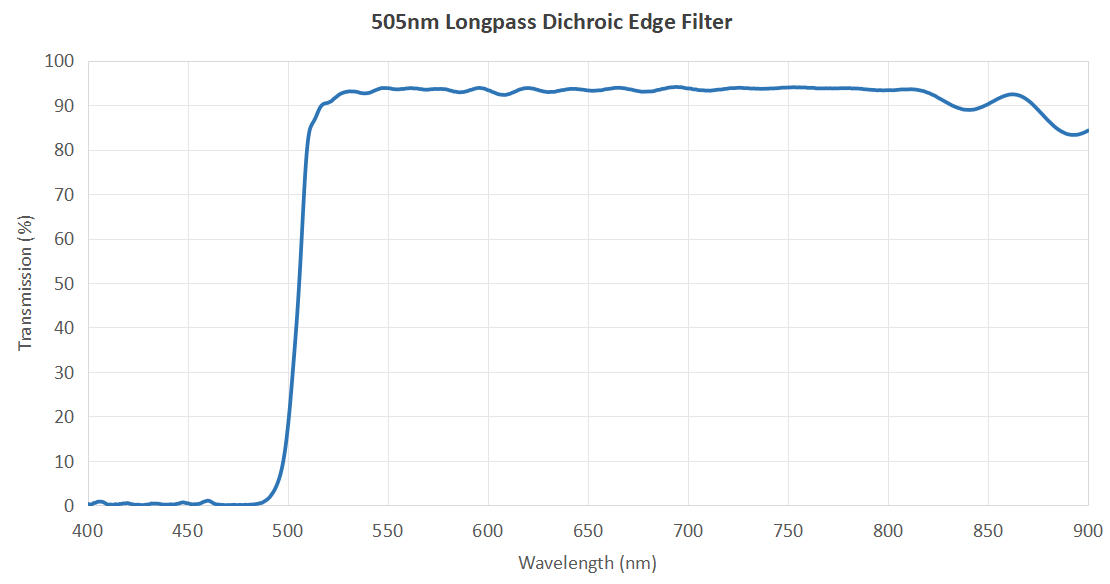
The 505nm Longpass Dichroic Edge Filter is a type of dichroic filter that reflects 390-490nm and transmits 505-800nm at an incidence angle of 45°. It is primarily used in fluorescence microscopes, flow cytometers, fluorescence imaging, confocal microscopes, multiphoton imaging, fluorescence spectrometers, and biomedical instruments to separate excitation and emission fluorescence, such as GFP, FITC, Alexa Fluor 488, and DyLight 488 fluorescent dyes, improving the fluorescence signal-to-noise ratio and imaging contrast.
Coligh Customs and Manufacturers’ dichroic filters employ a hard dielectric multilayer film design, deposited on fused silica, B270, or optical glass substrates. We can customize and match dichroic mirrors according to the fluorescent dye, excitation wavelength, and emission wavelength.
505nm Longpass Dichroic Edge Filter Key Features
It features the following:
- A 505nm long-pass design reflects short-wavelength blue light while transmitting long-wavelength green light and visible fluorescence.
- Optimized design with a 45-degree incident angle.
- Reflectivity greater than 99% in the 390-490nm band.
- Transmittance greater than 90% in the 505-800nm band.
The fused silica substrate has extremely low autofluorescence, making it suitable for weak fluorescence detection.
505nm Longpass Dichroic Edge Filter Spectrum
505nm Dichroic Beam Splitter Specification
- AOI: 45 deg
- 390-490nm@R>=99%
- 505-800nm@T>=90%
Stock List Of Dichroic Beamsplitter
| Angle of incidence | Reflection Range (nm) | Reflection (R%) | Transmission Range (nm) | Transmission (T%) |
|---|---|---|---|---|
| 45° | 415-630nm | Reflection 99% | 655-900nm | Transmission Above 90% |
| 45° | 915-940nm | Reflection 99% | 976nm | Transmission Above 95% |
| 45° | 600-750nm | Reflection 99% | 850-2500nm | Transmission Above 95% |
| 45° | 900-1250nm | Reflection 99% | 1350-2500nm | Transmission Above 90% |
| 45° | 900-1070nm | Reflection 99% | 1170-2500nm | Transmission Above 90% |
| 45° | 300-390nm | Reflection 99% | 415-800nm | Transmission Above 95% |
| 45° | 300-400nm | Reflection 99% | 430-800nm | Transmission Above 95% |
| 45° | 300-580nm | Reflection 99% | 600-800nm | Transmission Above 90% |
| 45° | 540-645nm | Reflection 99% | 665-800nm | Transmission Above 90% |
| 45° | 470-610nm | Reflection 99% | 640-900nm | Transmission Above 90% |
| 45° | 300-590nm | Reflection 99% | 620-800nm | Transmission Above 95% |
| 45° | 330-595nm | Reflection 99% | 630-850nm | Transmission Above 90% |
| 50.5° | 310-350nm | Reflection 99% | 400-700nm | Transmission Above 90% |
| 45° | 350-495nm | Reflection 99% | 515-800nm | Transmission Above 95% |
| 45° | 500-580nm | Reflection 99% | 600-800nm | Transmission Above 90% |
| 45° | 400-780nm | Reflection 99% | 330-385nm | Transmission Above 90% |
| 45° | 400-480 580-70nm | Reflection 99% | 500-550nm | Transmission Above 90% |
| 45° | 535-665 800-890nm | Reflection 99% | 410-510nm | Transmission Above 90% |
| 45° | 300-395nm | Reflection 99% | 420-800nm | Transmission Above 90% |
| 45° | 500-540nm | Reflection 99% | 560-600nm | Transmission Above 90% |
| 45° | 300-605nm | Reflection 99% | 630-800nm | Transmission Above 90% |
| 45° | 300-485nm | Reflection 99% | 510-800nm | Transmission Above 90% |
| 45° | 900-1100nm | Reflection 99% | 1200-1800nm | Transmission Above 90% |
| 45° | 200-300nm | Reflection 99% | 320-800nm | Transmission Above 90% |
| 45° | 350-540nm | Reflection 99% | 254-330nm | Transmission Above 90% |
| 45° | 915nm | Reflection 99% | 940nm | Transmission Above 95% |
| 45° | 915nm | Reflection 99% | 940nm | Transmission Above 95% |
| 45° | 350-790nm | Reflection 99% | 835-920nm | Transmission Above 90% |
| 45° | 300-395nm | Reflection 99% | 425-800nm | Transmission Above 90% |
| 45° | 300-485nm | Reflection 99% | 510-800nm | Transmission Above 90% |
| 45° | 480-735nm | Reflection 99% | 770-1100nm | Transmission Above 90% |
| 45° | 400-800nm | Reflection 99% | 900-1800nm | Transmission Above 90% |
| 45° | 350-540nm | Reflection 99% | 565-900nm | Transmission Above 90% |
| 45° | 575-1100nm | Reflection 99% | 400-550nm | Transmission Above 95% |
| 45° | 400-655nm | Reflection 99% | 675-800nm | Transmission Above 90% |
| 45° | 520-665nm | Reflection 99% | 730-890nm | Transmission Above 90% |
| 45° | 350-580nm | Reflection 99% | 610-800nm | Transmission Above 90% |
| 45° | 510-630nm | Reflection 99% | 660-900nm | Transmission Above 90% |
| 45° | 900-1400nm | Reflection 99% | 1500-2500nm | Transmission Above 90% |
| 45° | 610-670 | Reflection 99% | 730-800nm | Transmission Above 90% |
| 45° | 550-590 | Reflection 99% | 612-650nm | Transmission Above 90% |
| 45° | 470-590 | Reflection 99% | 610-900nm | Transmission Above 90% |
| 45° | 550-590 | Reflection 99% | 605-650nm | Transmission Above 90% |
| 45° | 300-440 | Reflection 99% | 460-800nm | Transmission Above 90% |
| 45° | 900-1400 | Reflection 99% | 1500-2500nm | Transmission Above 90% |
| 45° | 300-605nm | Reflection 99% | 640-900nm | Transmission Above 90% |
| 45° | 500-640nm | Reflection 99% | 660-800nm | Transmission Above 90% |
| 45° | 320-490nm | Reflection 99% | 510-800nm | Transmission Above 90% |
| 45° | 350-425nm | Reflection 99% | 445-800nm | Transmission Above 90% |
| 45° | 490-590nm | Reflection 99% | 620-800nm | Transmission Above 90% |
| 45° | 500-550nm | Reflection 99% | 600-620nm | Transmission Above 90% |
| 45° | 500-640nm | Reflection 99% | 665-800nm | Transmission Above 90% |
| 45° | 500-535nm | Reflection 99% | 560-600nm | Transmission Above 90% |
| 45° | 350-425nm | Reflection 99% | 445-800nm | Transmission Above 90% |
| 45° | 615-635nm | Reflection 99% | 655-800nm | Transmission Above 90% |
| 45° | 545-585nm | Reflection 99% | 610-650nm | Transmission Above 90% |
| 45° | 300-570nm | Reflection 99% | 600-900nm | Transmission Above 90% |
| 45° | 400-480 510-540nm | Reflection 99% | 565-800nm | Transmission Above 90% |
| 45° | 350-400nm | Reflection 99% | 430-800nm | Transmission Above 90% |
| 45° | 320-580nm | Reflection 99% | 640-1100nm | Transmission Above 90% |
| 45° | 920-975nm | Reflection 99% | 1030nm | Transmission Above 90% |
| 45° | 450-650nm | Reflection 99% | 750-1100nm | Transmission Above 90% |
| 45° | 500-640nm | Reflection 99% | 660-800nm | Transmission Above 90% |
| 45° | 360-460nm | Reflection 99% | 510-800nm | Transmission Above 90% |
| 45° | 400-480 565-575nm | Reflection 99% | 510-530 615-700nm | Transmission Above 90% |
| 45° | 500-615 910-1020nm | Reflection 99% | 660-850nm | Transmission Above 90% |
| 45° | 350-480nm | Reflection 99% | 510-800nm | Transmission Above 90% |
| 45° | 400-480 550-590nm | Reflection 99% | 517-533 617nm | Transmission Above 90% |
| 45° | 300-445nm | Reflection 99% | 470-800nm | Transmission Above 90% |
| 45° | 350-480nm | Reflection 99% | 510-800nm | Transmission Above 90% |
| 45° | 355nm | Reflection 99% | 400-500nm | Transmission Above 90% |
| 45° | 350-400nm | Reflection 99% | 430-800nm | Transmission Above 90% |
| 45° | 350-480nm | Reflection 99% | 515-800nm | Transmission Above 90% |
| 45° | 440-485nm | Reflection 99% | 510-550nm | Transmission Above 90% |
| 45° | 590-650nm | Reflection 99% | 670-750nm | Transmission Above 90% |
| 45° | 600-680nm | Reflection 99% | 450-550nm | Transmission Above 90% |
| 45° | 440-490nm | Reflection 99% | 510-550nm | Transmission Above 90% |
| 45° | 550-695nm | Reflection 99% | 715-800nm | Transmission Above 90% |
| 45° | 200-490nm | Reflection 99% | 535-800nm | Transmission Above 90% |
| 45° | 200-460 600-1100nm | Reflection 99% | 480-580nm | Transmission Above 90% |
| 45° | 900-1550nm | Reflection 99% | 1650-2300nm | Transmission Above 95% |
| 45° | 390-490nm | Reflection 99% | 505-800nm | Transmission Above 90% |
| 45° | 470-595nm | Reflection 99% | 610-800nm | Transmission Above 90% |
| 45° | 900-1550nm | Reflection 99% | 1650-2300nm | Transmission Above 95% |
| 45° | 380-485nm | Reflection 99% | 510-800nm | Transmission Above 90% |
| 45° | 200-680nm | Reflection 99% | 740-1200nm | Transmission Above 90% |
| 45° | 400-480 560-580nm | Reflection 99% | 515-535 610-700nm | Transmission Above 90% |
| 45° | 500-530nm | Reflection 99% | 555-600nm | Transmission Above 90% |
| 45° | 345-415nm | Reflection 99% | 440-800nm | Transmission Above 90% |
| 45° | 900-1100nm | Reflection 99% | 1350-1600nm | Transmission Above 98% |
| 45° | 400-480 500-540nm | Reflection 99% | 570-800nm | Transmission Above 90% |
| 45° | 450-590nm | Reflection 99% | 615-1200nm | Transmission Above 95% |
| 45° | 515-600nm | Reflection 99% | 450-495 nm | Transmission Above 90% |
| 45° | 600-755nm | Reflection 99% | 780-1100nm | Transmission Above 90% |
| 45° | 300-410nm | Reflection 99% | 430-1100nm | Transmission Above 95% |
| 45° | 300-360nm | Reflection 99% | 380-1100nm | Transmission Above 95% |
| 45° | 300-390nm | Reflection 99% | 410-600nm | Transmission Above 95% |
| 45° | 300-415nm | Reflection 99% | 440-1100nm | Transmission Above 90% |
| 45° | 400-490nm | Reflection 99% | 510-800nm | Transmission Above 95% |
| 45° | 300-620nm | Reflection 99% | 640-1100nm | Transmission Above 90% |
| 45° | 400-580nm | Reflection 99% | 605-1200nm | Transmission Above 90% |
| 45° | 400-545 nm | Reflection 99% | 565-900nm | Transmission Above 90% |
| 45° | 550-640nm | Reflection 99% | 660-800nm | Transmission Above 90% |
| 45° | 400-480nm | Reflection 99% | 500-800nm | Transmission Above 90% |
| 45° | 400-485nm | Reflection 99% | 510-800nm | Transmission Above 90% |
| 45° | 1260-1800nm | Reflection 99% | 750-1200nm | Transmission Above 90% |
| 45° | 440-490nm | Reflection 99% | 515-550nm | Transmission Above 90% |
| 45° | 400-575nm | Reflection 99% | 600-1100nm | Transmission Above 90% |
| 45° | 300-385nm | Reflection 99% | 405-1100nm | Transmission Above 90% |
| 45° | 300-360nm | Reflection 99% | 380-1100nm | Transmission Above 90% |
| 45° | 300-445nm | Reflection 99% | 470-900nm | Transmission Above 90% |
| 45° | 400-595nm | Reflection 99% | 620-900nm | Transmission Above 90% |
| 45° | 300-405nm | Reflection 99% | 435-1100nm | Transmission Above 90% |
| 45° | 380-430nm | Reflection 99% | 340-360nm | Transmission Above 95% |
| 45° | 300-670nm | Reflection 99% | 700-900nm | Transmission Above 90% |
| 45° | 830-1200nm | Reflection 99% | 405-795nm | Transmission Above 90% |
| 45° | 575-700nm | Reflection 99% | 380-555nm | Transmission Above 95% |
| 45° | 435-700nm | Reflection 99% | 380-415nm | Transmission Above 95% |
| 45° | 610-700nm | Reflection 99% | 380-580nm | Transmission Above 95% |
| 45° | 395-750nm | Reflection 99% | 330-375nm | Transmission Above 90% |
| 45° | 300-445nm | Reflection 99% | 465-900nm | Transmission Above 90% |
| 45° | 360-540nm | Reflection 99% | 560-800nm | Transmission Above 95% |
| 45° | 360-490nm | Reflection 99% | 510-800nm | Transmission Above 95% |
| 45° | 800-1100nm | Reflection 99% | 400-700nm | Transmission Above 95% |
| 45° | 380-580nm | Reflection 99% | 605-800nm | Transmission Above 90% |
| 45° | 380-640nm | Reflection 99% | 660-900nm | Transmission Above 95% |
| 45° | 520-700nm | Reflection 99% | 380-500nm | Transmission Above 95% |
| 45° | 500-645nm | Reflection 99% | 665-900nm | Transmission Above 90% |
| 45° | 400-705nm | Reflection 99% | 745-1100nm | Transmission Above 95% |
| 45° | 400-640nm | Reflection 99% | 660-900nm | Transmission Above 90% |
| 45° | 400-650nm | Reflection 99% | 675-900nm | Transmission Above 90% |
| 45° | 420-555nm | Reflection 99% | 580-1100nm | Transmission Above 90% |
| 45° | 500-635nm | Reflection 99% | 655-900nm | Transmission Above 95% |
| 45° | 580-1100nm | Reflection 99% | 420-555nm | Transmission Above 90% |
| 45° | 350-430nm | Reflection 99% | 470-1600nm | Transmission Above 90% |
| 45° | 1110-1800nm | Reflection 99% | 1064nm | Transmission Above 95% |
| 45° | 590-755nm | Reflection 99% | 785-1100nm | Transmission Above 90% |
| 45° | 800-1130nm | Reflection 99% | 1175-1430nm | Transmission Above 95% |
| 45° | 800-1215nm | Reflection 99% | 1255-1430nm | Transmission Above 95% |
| 45° | 800-1100nm | Reflection 99% | 400-700nm | Transmission Above 95% |
| 45° | 800-960 nm | Reflection 99% | 990-1100nm | Transmission Above 95% |
Coligh Customize Capability Of Dichroic Filter
| Parameter | Specification |
|---|---|
| Substrate Material | UV Fused Silica, B270 |
| Dimensions and Shape | Circular or Square from 2 mm to 150 mm |
| Filter Type | Longpass Dichroic Filter, Shortpass Dichroic Filter, Multiband Dichroic Filter |
| Reflectance (R) and Transmittance (T) Performance | R > 99%; T > 90% or T > 95% |
| Surface Quality | 60-40, 40-20 |
| Flatness | λ/10, λ/4 @ 632.8 nm |
| Coating Technology | IAD (Ion-Assisted Deposition) Hard Coating |
505nm Dichroic Reflector Applications
Fluorescence Microscopy (GFP/FITC)
In fluorescence microscopy, the excitation peaks of dyes such as GFP, FITC, Alexa Fluor 488, and DyLight 488 are typically around 488 nm, while their emission peaks are above 510–530 nm. The excitation light intensity is much higher than the emission fluorescence. If the excitation light leaks into the detector channel, it will mask the weak fluorescence signal, reducing the signal-to-noise ratio and image contrast. A 505 nm long-pass dichroic mirror, installed at 45°, reflects blue excitation light below 505 nm to the sample, while allowing green/visible fluorescence above 505 nm to pass through to the detector, achieving efficient separation.
Flow Cytometry
In flow cytometry, weak fluorescence signals, excitation light leakage, and ambient light can reduce detection sensitivity and resolution. A 505 nm long-pass dichroic mirror can be used to separate 488 nm blue excitation light and green fluorescence above 510 nm, improving signal purity and detection accuracy.
Fluorescence Spectrometer
A fluorescence spectrometer requires the separation of blue excitation light and green emission fluorescence. A 505 nm long-pass dichroic mirror can effectively suppress excitation light leakage, improve spectral purity, and reduce background noise and stray light. It is suitable for materials analysis, chemical detection, biological analysis, and environmental monitoring.