532/30nm Narrrow Band Rejection Filter | Notch Filter Manufacturer
Coligh customs and manufactures 532/30nm Narrrow Band Rejection Filter. This notch filter provides 532 nm laser line removal notch filters with a 30 nm band rejection bandwidth.
532/30nm Narrrow Band Rejection Filter Overview
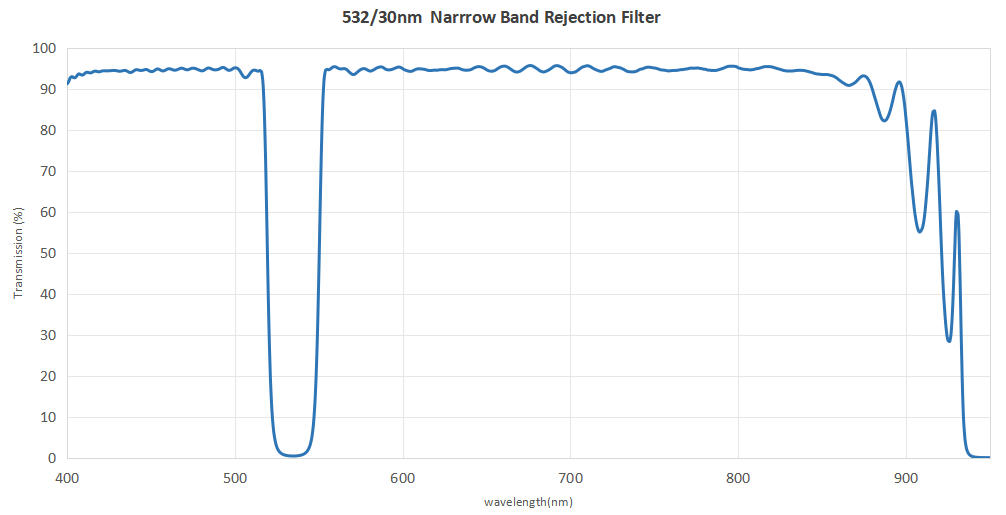
The 532/30nm narrow-band rejection filter—also known as a 532/30nm notch filter—is designed to block a specific band centered at 532 nm (with a bandwidth of approximately 30 nm) while offering high transmission across the 400–800 nm range. As a manufacturer of notch filters, Coligh utilizes a hard-dielectric multilayer coating process. Our band-rejection filters feature high optical density (OD) within the rejection band, a sharp transition, and high transmission in the passband. They are ideally suited for applications requiring the suppression of a 532 nm laser line, such as laser safety, Raman spectroscopy, fluorescence imaging, and laser confocal microscopy.
532/30nm Narrrow Band Rejection Filter Key Features
It features the following core characteristics:
- The center wavelength of the stopband is 532 nm, with a bandwidth of 30 nm, effectively suppressing the 532 nm laser line.
- The blocking depth (transmission T) is <0.5%, which effectively reduces stray light and sharp-angle scattering.
- It offers high passband transmission, with a transmittance of over 90% across the 400–800 nm range.
- We utilize hard-dielectric coatings applied via ion-assisted deposition, resulting in robust, wipe-resistant layers with excellent environmental stability.
532/30nm Optical Notch Filter Spectrum
532/30nm Narrrow Band Rejection Filter Specification
- bandstop wavelength: 532nm
- Bandstop FWHM: 30nm
- Notch transmission: T<0.5%@blocking depth: OD2.5
- Transmission range: 400-850nm
- AOI: 0 deg
Coligh Customize Capability Of bandstop filter
Coligh possesses comprehensive capabilities—spanning in-house R&D and thin-film coating production to volume delivery—that support everything from small-batch prototyping to large-scale supply. We offer the flexibility to meet our clients’ evolving needs, whether they are in the project validation phase or full-scale mass production.
Our products utilize hard-dielectric coating technology, with cut-off depth and passband transmission optimized for specific applications. We provide measured spectral curves and inspection reports, ensuring that all delivered specifications are both traceable and verifiable.
We offer fully integrated customization covering wavelength, bandwidth, dimensions, angle of incidence, and mounting configurations—and can collaborate on the design to ensure seamless alignment with your optical path and mechanical structure.
| Customization Parameter | Available Options |
|---|---|
| Center Wavelength (CWL) | Standard laser wavelengths: 325 nm, 532 nm, 633 nm, and 1064 nm; customizable range: 200–2000 nm |
| Stopband Width | ≥ 5 nm |
| Stopband Optical Density (OD) | OD 2–OD 6 |
| Passband Transmission | Average transmittance in the passband: T > 90% or T > 93% |
| Angle of Incidence (AOI) | 0°–45° |
| Substrate Material | UV Fused Silica; N-BK7; high-quality optical glass |
532/30nm Band-elimination Filter Applications
Raman Spectroscopy
Raman spectroscopy typically employs a 532 nm laser to excite a sample. Since the Raman scattering signal is extremely weak compared to the excitation light, any 532 nm laser light that is not sufficiently suppressed can overwhelm the Raman signal and elevate the background. A 532/30 nm band-rejection filter provides a high-rejection band centered around 532 nm, blocking the laser light, Rayleigh scattering, and some stray light; this reduces the background caused by the 532 nm excitation source and enhances the contrast of Raman peaks.
Fluorescence Microscopy
In fluorescence microscopy and laser confocal systems, a 532 nm laser is used to excite fluorescent probes. However, reflections and scattering of the excitation light can enter the detection channel, thereby reducing image contrast. A band-rejection filter can be placed in the detection path to block the 532 nm laser light while allowing the majority of the fluorescence emission spectrum to pass through, effectively reducing background noise.
Laser Safety and Protection
In optical systems, 532 nm lasers can generate reflections, back-reflections, and stray light, which may interfere with detection, compromise operational safety, or degrade measurement accuracy. A 532 nm band-rejection filter provides high-level attenuation at 532 nm while allowing other operational wavelength bands to be transmitted.
Biomedical Imaging
In biomedical imaging, spectroscopic analysis, and scientific research optical setups, a 532 nm laser is frequently used as an excitation source. If the excitation line enters the detection channel, it raises the background level and reduces the dynamic range. A 532 nm band-rejection filter is used to eliminate the 532 nm laser line, preserving target signals—such as fluorescence, scattered light, or Raman signals—and improving the signal-to-noise ratio of the detection.