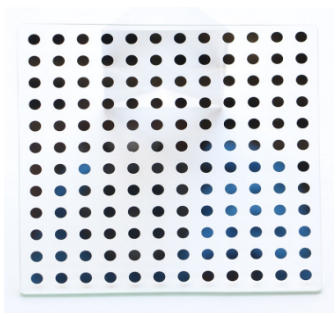
Circle Dot Test Calibration Target Plate
Coligh is a manufacturer of dot calibration plates, employs photolithography on soda-lime glass, fused quartz, and ceramic substrates to produce dot array calibration plates.
Circle Dot Test Calibration Target Plate Product Overview
High-precision circular dot calibration plates serve as fundamental measurement tools for machine vision and metrology, featuring precisely dimensioned dot patterns arranged in orderly arrays. Coligh, as a manufacturer of dot calibration plates, employs photolithography on soda-lime glass, fused quartz, and ceramic substrates to produce dot array calibration plates. These are widely utilized in machine vision applications for lens distortion correction, multi-camera synchronization, and robotic navigation and guidance. We offer dot grids with dot sizes of 0.01mm and larger, customizable from small to large dimensions.
Circle Dot Test Calibration Target Plate Product Features
We utilize advanced photolithography technology to manufacture dot calibration plates, featuring the following characteristics:
- We can produce circular, radial patterns, or custom designs based on client specifications.
- Dot diameters range from 0.01mm to 5mm.
- Dot diameter, center-to-center spacing, and quantity can be precisely manufactured to client requirements.
- We offer soda-lime glass, ceramic, and fused silica substrates, allowing clients to select the most suitable base material.
Circle Dot Test Calibration Target Plate Picture
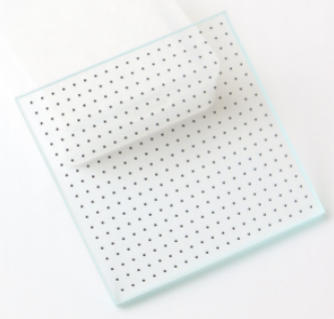
Custom Capability Of Circle Dot Test Calibration Target Plate
| Custom Capability | Discription |
|---|---|
| Substrate | Soda lim glass, fused silica, ceramic plate |
| Pattern Processing | Lithography |
| Patterns | Rectangular, circular, and custom-sized arrays |
| Glass Positioning precision | 1um |
| Ceramic Positioning Precision | 2um |
| Dot diameter | 0.01-5mm or custom |
| Thin Film Coating | Custom |
| Glass Thickness | 1.0mm |
| Ceremic thickness | 2.0mm |
Circle Dot Test Calibration Target Plate Applications
- Machine Vision
On automated production lines, camera lenses introduce distortion that causes image distortion. Therefore, cameras must be calibrated to eliminate system errors. A calibration target allows the camera to capture images of the target from multiple angles and positions. Vision software then calculates the camera parameters to measure all workpieces. - Robotic Vision
For robots to accurately grasp or manipulate objects, precise spatial relationships between the robot’s end-effector and camera must be known. By positioning a fixed calibration plate at various locations while the robot’s end-effector moves the plate to different positions, a stationary camera captures images. This enables precise grasping and placement. - 3D Scanning
Multiple components of 3D scanning systems, such as structured light and laser systems, require operation within a unified, precise coordinate system. By scanning and capturing the calibration plate from multiple angles using the 3D scanning system, the relative position and orientation between the camera and projector can be calculated to ensure the accuracy of the 3D data.