
1D Circular Linear Microlens Array
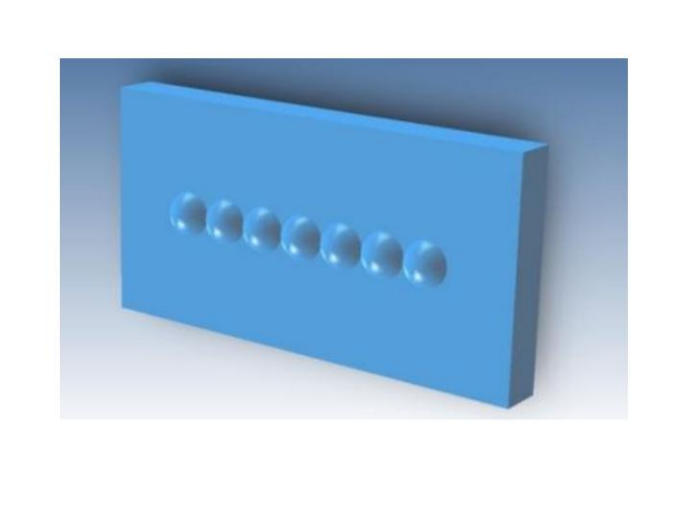
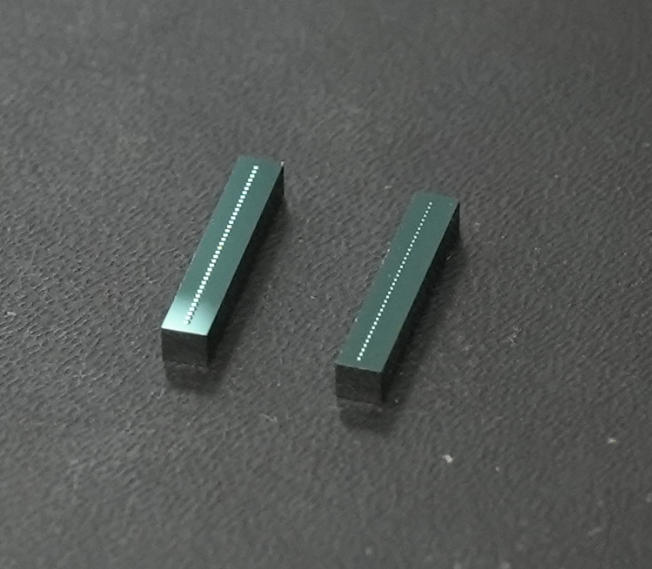
Coligh’s 1D circular linear micro-lens array is a micro-lens array composed of 1D plano-convex circular lenses uniformly arranged along the X-axis. In this micro-lens array, each plano-convex circular lens can focus and shape light. It is typically used for linear shaping, collimation, homogenization, focusing, and spatial beam splitting of light beams.
- Sub-lens Shape: Circular
- Lens Arrangement: One-dimensional direction
- Lens Type: Refractive, Plano-convex
- Pitch Accuracy: ± 1 μm
- Applications: Optical collimation, fiber coupling
Key Features Of Coligh’s Linear Microlens Array
- 1. All plano-convex lenses are uniformly arranged along the X-axis, suitable for collimating and shaping rod-shaped or line-shaped light sources.
- 2. The lens design features aspherical lenses.
- 3. It can form linear light spots, making it ideal for applications such as scanning, line-array lasers, and fiber arrays for precise focusing or uniformizing light sources.
- 3. The function of each plano-convex circular sub-unit lens can be used for aberration control and adjusting the angle, focal position, and intensity distribution of light.
- 4. The circular sub-lens array maximizes the effective light transmission area.
- 5. It is highly suitable for integration into laser modules and optical communication modules for light collimation and fiber coupling.
Coligh’s Independent in-house Linear Microlens Manufacturing Capability
| Item | Custom Specification |
|---|---|
| Wavelength Range | 200 nm – 20 μm |
| Material Options | Fused Silica, Monocrystalline Silicon, PMMA |
| Microlens Shape | Square, Round, Spherical, Aspherical, Freeform |
| Sub-aperture Size | 10 μm – 1500 μm |
| Diffraction Efficiency | Up to 80% – 90% |
| Focal Length | Supports both short and long focal lengths |
| Phase Levels | 8-level and above, continuous phase available |
| Overall Size | Diameter 1.5 mm – 4 inch |
| Thickness | Flexible (any thickness) |
| Coating | AR or HR coatings available for 200 nm – 20 μm |
| Beam Shape | Round, Square, or Custom Freeform |
| Dot Array | Up to 33 × 33 |
| Applications | Fiber Coupling, Beam Calibration, Imaging |
Fused silica 1D Linear Microlens Array Product Series:
| Product No. | Sub-Dia. | Pitch | EFL. | Array | Dim. | T. | WL | ROC | C.C. | N.A. |
|---|---|---|---|---|---|---|---|---|---|---|
| MLLQ(R)-127 | 125.0μm | 127.0μm | 5,00 | 109×3 | 14×1.0 | 1 | 1.55μm | -222,00 | 0 | 125,00 |
| MLLQ(R)-250 | 248.0μm | 250.0μm | 74,00 | 50×3 | 14×1.5 | 1 | 1.55μm | -33,00 | 0 | 167,00 |
| MLLQ(R)-500 | 495.0μm | 500.0μm | 5,00 | 25×3 | 14×1.5 | 1 | 1.55μm | -222,00 | 0 | 5,00 |
Silicon 1D Linear Microlens Array Product Series
| Product No. | Sub-Dia. | Pitch | FFL. | Dim. | T. | WL | ROC | C.C. | N.A. |
|---|---|---|---|---|---|---|---|---|---|
| MLLS(R)-127 | 125.0μm | 127.0μm | 34,00 | 14×1 | 1 | 1.55μm | -85,00 | 0 | 182,00 |
| MLLS(R)-250 | 248.0μm | 250.0μm | 67,00 | 14×1.5 | 1 | 1.55μm | -165,00 | 0 | 186,00 |
| MLLS(R)-500 | 480.0μm | 500.0μm | 182,00 | 14×1.5 | 1 | 1.55μm | -45,00 | 0 | 132,00 |
Coligh Deep Ultraviolet Lithography and Laser Direct Writing Process for Linear Micro-Lens Arrays
- Batch Lithography: We employ deep ultraviolet lithography micro/nanofabrication processes for batch etching of linear micro-lens arrays and large-scale production, ensuring high precision, batch consistency, and reliable cycle structures.
- Laser Direct Writing: For rapid design prototyping, in addition to lithography, we also utilize laser direct writing to inscribe linear micro-lens patterns onto photoresist.
How is our quality control over Linear microlens arrays
- One-dimensional profilometer:
We use a one-dimensional profilometer to measure the surface profile cross-section of linear microlens arrays. This includes measuring the height of the lenses, profile symmetry, and repeatability of adjacent units, ensuring that the positional accuracy error of each lens unit is less than or equal to +/-1um - 3D profilometer:
We use a 3D profilometer to measure the size of the sub-apertures in the linear microlens array, surface shape errors, surface roughness, and defect detection, ensuring consistency in EFL and dispersion in ROC. - Interferometer:
We use an interferometer to detect the spherical profile, surface profile errors, wavefront distortion, and numerical aperture of the sub-lenses. - Spectrophotometer:
We use a spectrophotometer to detect the overall spectral performance from the ultraviolet to the far-infrared wavelength range.
1D Linear Microlens Arrays Applications:
- Light Collimation
In VCSELs and laser diodes, the laser emits a highly divergent beam. Through a linear microlens array, each sub-lens can collimate or focus a single laser beam, enabling the collimation or shaping of multiple divergent beams into uniformly distributed light rays and linear spots. - Fiber Coupling
In multi-core fiber arrays and VCSELs, fiber coupling requires high alignment accuracy. A linear microlens array can be placed between the light source array and the fiber array to focus light onto the fiber endface. By adjusting the spot size, controlling the divergence angle, and other parameters, coupling loss can be minimized.