390nm Optical Shortpass Fluorophore Excitation Filter
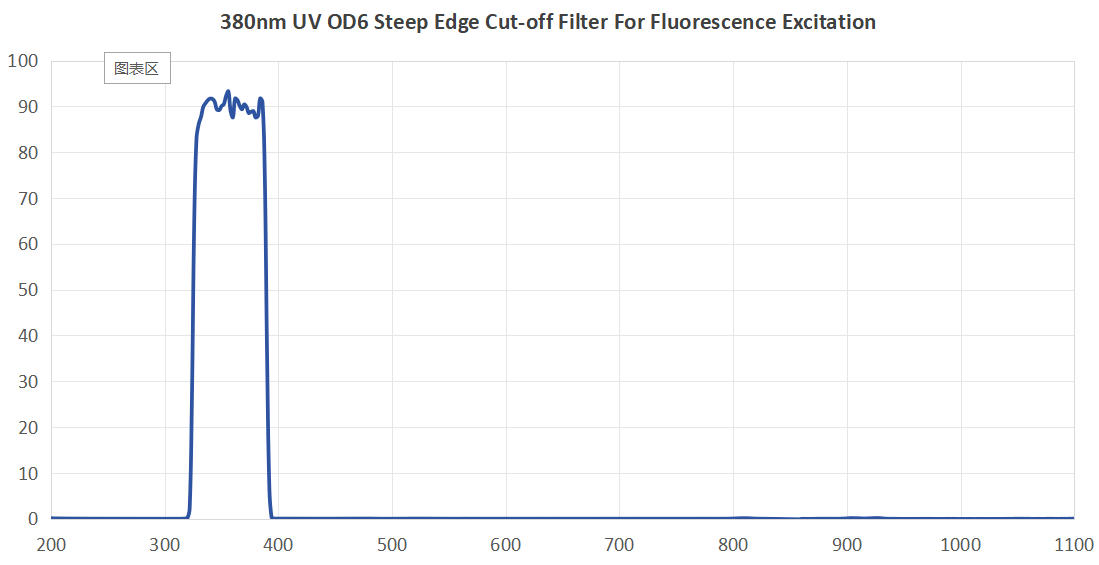
380nm UV OD6 Steep Edge Cut-off Filter is a shortpass filter to block the wavelength longer than 380nm with OD6 blocking depth and transmit 330-380nm with high transmission. Coligh customs and manufactures UV shortpass edge filters for fluorescence applications.
390nm Optical Shortpass Fluorophore Excitation Filter Overview
The 390nm Optical Shortpass Fluorophore Excitation Filter is a shortpass filter primarily made of fused silica with a thin film coating. It features high OD depth cutoff in the 390nm long-wavelength direction and high transmittance in the 390nm short-wavelength direction. Used in fluorescence excitation channels, it allows ultraviolet excitation light to pass through while significantly suppressing visible emission fluorescence, stray light, and background light, thus improving the fluorescence signal-to-noise ratio and detection sensitivity.
Therefore, it is often used as a DAPI excitation filter, Hoechst 33258/Hoechst 33342 excitation filter, Alexa Fluor 350/AMCA excitation filter, or other UV-excitable fluorophores filters.
Coligh, as a manufacturer of optical filters, specializes in thin-film interference filters, hard-film short-wavelength filters, and high-cutoff-depth short-wavelength filters. Our products are commonly used as key components in instruments such as fluorescence microscopes, UV fluorescence imaging, fluorescence spectrometers, ultraviolet fluorescence immunoassay analyzers, and point-of-care testing (POCT).
390nm Optical Shortpass Fluorophore Excitation Filter Key Features
- The 390nm short-pass design allows for high UV transmittance below 390nm, making it suitable for UV fluorescence excitation channels.
- The OD4-OD6 cutoff depth suppresses visible light and stray light.
- The short transition region improves the separation between excitation and emission.
- The UV-grade fused silica substrate exhibits low autofluorescence, making it suitable for weak fluorescence detection.
390nm Optical Shortpass Fluorophore Excitation Filter Spectrum
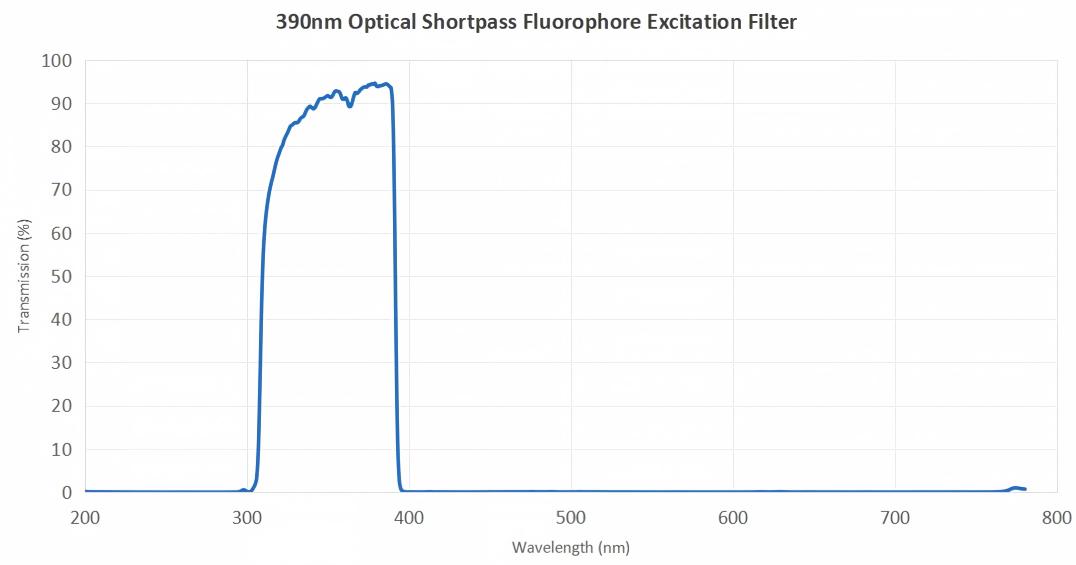
390nm UV Short-edge Fluorophore Excitation Filter Specification
- 50% cut off:390+/-5nm
- 400-780nm@OD6 blocking depth
- Tp>=80%@322-390nm
Stock List Of Optical Shortpass Cut-off Filter
| Filter | 50% Cut Off wavelength | Transmission Peak(T%) | High Transmission Range (nm) | Blocking Range (nm) | Blocking depth (T%) |
|---|---|---|---|---|---|
| Shortpass Filter 455nm | 455 | 85 | 380-445 | 470-750 | OD4 |
| Shortpass Filter 490nm | 490 | 90 | 500-765 | 340-485 | OD4 |
| Shortpass Filter 490nm | 490 | 90 | 400-480 | 510-650 | OD3 |
| Shortpass Filter 505nm | 505 | 90 | 400-500 | 520-1000 | OD3 |
| Shortpass Filter 600nm | 600 | 90 | 400-590 | 610-1200 | OD4 |
| Shortpass Filter 650nm | 650 | 95 | 400-640 | 665-1100 | OD4 |
| Shortpass Filter 650nm | 650 | 90 | 420-630 | 670-1100 | OD2 |
| Shortpass Filter 650nm | 650 | 95 | 400-535 | 665-1020 | OD5 |
| Shortpass Filter 650nm | 650 | 95 | 400-635 | 660-1000 | OD2 |
| Shortpass Filter 650nm | 650 | 90 | 420-620 | 680-1100 | OD2 |
| Shortpass Filter 650nm | 650 | 95 | 400-640 | 665-1100 | OD5 |
| Shortpass Filter 675nm | 675 | 90 | 400-650 | 700-1100 | OD2 |
| Shortpass Filter 690nm | 690 | 90 | 420-685 | 710-1100 | OD3 |
| Shortpass Filter 690nm | 690 | 90 | 330-685 | 705-1200 | OD1 |
| Shortpass Filter 690nm | 690 | 90 | 420-650 | 730-1100 | OD2 |
| Shortpass Filter 700nm | 700 | 95 | 400-690 | 715-1080 | OD5 |
| Shortpass Filter 700nm | 700 | 90 | 400-685 | 725-1100 | OD4 |
| Shortpass Filter 700nm | 700 | 90 | 200-385 | 725-1100 | OD2 |
| Shortpass Filter 700nm | 700 | 95 | 400-690 | 720-1200 | OD3 |
| Shortpass Filter 705nm | 705 | 90 | 400-695 | 720-1100 | OD3 |
| Shortpass Filter 710nm | 710 | 90 | 400-700 | 725-1100 | OD3 |
| Shortpass Filter 710nm | 710 | 95 | 550-700 | 740-1100 | OD4 |
| Shortpass Filter 720nm | 720 | 95 | 410-690 | 730-1100 | OD2 |
| Shortpass Filter 720nm | 720 | 95 | 410-690 | 730-1100 | OD2 |
| Shortpass Filter 730nm | 730 | 95 | 400-720 | 740-1100 | OD2 |
| Shortpass Filter 730nm | 730 | 95 | 400-720 | 740-1100 | OD2 |
| Shortpass Filter 750nm | 750 | 90 | 500-730 | 780-1100 | OD5 |
| Shortpass Filter 750nm | 750 | 94 | 400-735 | 770-1100 | OD3 |
| Shortpass Filter 750nm | 750 | 95 | 420-740 | 760-1200 | OD6 |
| Shortpass Filter 800nm | 800 | 90 | 400-790 | 820-1100 | OD2 |
| Shortpass Filter 800nm | 800 | 90 | 400-790 | 820-1100 | OD2 |
| Shortpass Filter 830nm | 830 | 90 | 450-800 | 960-1200 | OD5 |
| Shortpass Filter 890nm | 890 | 90 | 500-850 | 980-1520 | OD2 |
| Shortpass Filter 895nm | 895 | 95 | 400-885 | 915-1350 | OD3 |
| Shortpass Filter 900nm | 900 | 95 | 400-895 | 930-1150 | OD3 |
| Shortpass Filter 980nm | 980 | 90 | 600-960 | 1000-1200 | OD5 |
Coligh Customize Capability Of Shortpass UV Fluorescence Exitation Filter
As a professional optical filter manufacturer, we specialize in solving the core challenges of fluorescence imaging and analytical systems: eliminating excitation leakage, suppressing background autofluorescence, and achieving sharp spectral separation. We operate complete, independent production lines ranging from UV-grade substrate processing to high-precision thin-film coating, allowing us to tailor cut-on/cut-off wavelengths, steep transition slopes, OD blocking depths, dimensions, shapes, and incident angles (AOI) to your exact fluorescence optical path.
| Customization Parameter | Available Range & Options |
|---|---|
| Wavelength Options | • UV range from 160-400nm (such as 365nm, 380nm, 390nm, 400nm) |
| Wavelength allowance | Within 5nm for cut off wavelength |
| Blocking range | 200-1100nm or custom according to request |
| Blocking depth | Standard OD4 - OD5, up to OD6 |
| High UV Transmission | • High transmission in UV band: 85%, 90% |
| Substate | UV low-autofluorescence Fused Silica |
| Size dimension | 2-150mm |
| AOI Customization | 0°-45° |
| Mounting Options | Mounted in black anodized aluminum rings or unmounted |
| Surface Quality | 60-40, 40-20 |
| Thin film coating technology | • Ion-Assisted Deposition (IAD) hard thin-films |
390nm UV Shortpass Interference Filter Applications
Fluorescence Microscopy for Nuclear Imaging
In cell biology, DAPI or Hoechst dyes are commonly used to label cell nuclei (DNA). The absorption/excitation peaks of these dyes are concentrated in the 350nm–390nm region. Using a 390nm short-pass filter as the excitation filter allows for precise matching of the absorption characteristics of these dyes, ensuring they absorb photons, reach an excited state, and emit bright blue fluorescence.
Flow Cytometry
Flow cytometry requires the simultaneous detection of cell populations labeled with multiple fluorescent antibodies using lasers or high-intensity light sources. When using ultraviolet or near-ultraviolet lasers (such as semiconductor lasers/LEDs near 355nm or 375nm/395nm), filters are needed to precisely control the excitation light spectrum entering the flow cell, preventing stray light from interfering with the fluorescence signals of other channels. A 390nm short-pass filter ensures spectral isolation between fluorescence channels in multicolor flow cytometry, reducing signal crosstalk.
Fluorescence In Situ Hybridization
FISH technology uses fluorescently labeled DNA probes to detect chromosomal or gene abnormalities. Many early classical fluorophores (such as AMCA or certain UV-excited fluoresceins) require high-energy, short-wavelength light for excitation. Using a 390nm excitation filter provides the optimal excitation energy and completely blocks other light sources that may cause nonspecific background interference.
Water Quality Testing
In environmental science, dissolved organic matter in water bodies exhibits natural fluorescence properties and typically requires excitation with ultraviolet light (300nm-400nm range) to study its composition and origin. A 390nm short-pass filter can precisely extract a specific segment of short-wavelength excitation light from a broad-spectrum light source.