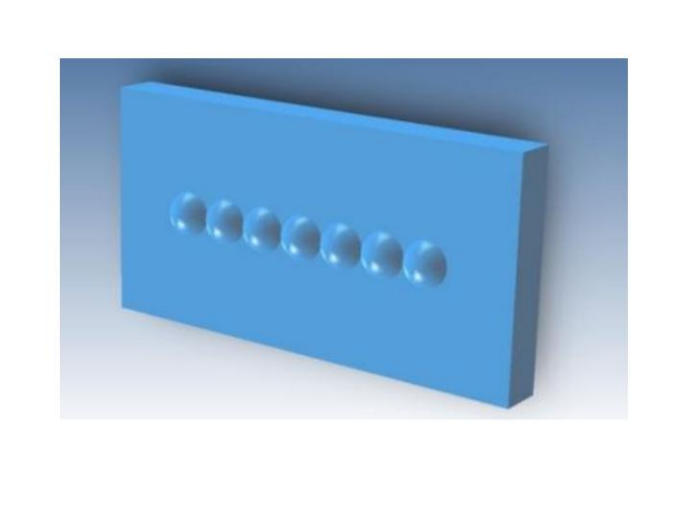
1310nm Fiber Coupling Collimation Micro lens Array
Coligh is the China manufacturer of 1310nm fiber coupling collimation micro lens array. We use precision photolithography to etch micro lens arrays, which are mainly used for optical fiber collimation applications.
1310nm Fiber Micro-lens Array collimation Coupler Product Discription
The 1310nm wavelength, due to its low dispersion characteristics, is well-suited for short-circuit terminations in optical fiber communications. It is suitable for metropolitan area networks, data center interconnects, enterprise LANs, fiber-to-the-home access networks, and short-haul high-speed communications.
The 1310nm micro-lens array collimation coupler can convert the divergent beam from each fiber into a collimated parallel beam. Alternatively, at the fiber-to-module or module-to-fiber interface, the micro-lens array can couple the collimated light into another fiber.
Coligh uses photolithography technology to manufacture 1310 nm fiber coupling collimation microlens arrays. Our 1310 nm Fiber Coupling Collimation Microlens Arrays can handle multiple fiber channels, ensuring low insertion loss and low crosstalk across multi-channel fibers.
Advantage Of Coligh’s g 1310nm Fiber Collimation Microlens Arrays
- A one-dimensional design allows for multiple optical fiber collimation. Supports 1, 2, 4, 8, or 16 channels.
- Equipped with AR coating to reduce reflections, the micro-array lens is aligned with the fiber matrix array to minimize errors and achieve precise alignment.
- Silicon and fused silica are used as substrates. Silicon’s high refractive index enables the design of short-focal-length, high-numerical-aperture micro-array lenses, while fused silica’s excellent thermal stability makes it suitable for applications with large temperature fluctuations.
- The 1310nm and 1550nm wavelengths perfectly match the requirements of the fiber-optic telecommunications industry.
Coligh Micro-lens Array Collimation Coupler Product Custom Capability
Our precision photolithography technology allows us to design and produce precision microlens arrays specifically for fiber alignment applications. Currently, we offer both 1xN one-dimensional microlens arrays and NXN two-dimensional microlens arrays.
Our microlens arrays are fully customizable to meet specific project requirement, we support to custom according to substrate material, lens type, array configuration, NA, MFD and coatings tailored to the fiber applications.
| Feature | Specification / Options |
|---|---|
| Lens type | Spherical & Aspherical Microlens Arrays |
| Arrangement of Microlens | 1D & 2D (Linear, round, Square, Hexagonal or Custom) |
| Substrate Materials | Fused silica and Silicon |
| Wavelength Range | 200nm to 20μm |
| Applications | Data center interconnects, Enterprise LANs, Fiber-to-the-home access networks, hort-haul high-speed communications. |
| Numerical Aperture (NA) | fast/slow axis collimation |
| Mode Field Diameter (MFD) | Customizable |
| Beam / Output Diameter | Customizable |
| Fiber / Waveguide Types | SMF, MMF, LD, PIC, Silicon photonics |
| Back Focal Length | Customizable |
| Pitch Options | Customizable |
| Notes | Fully customizable design available to meet specific project requirements |
1310nm Fiber Coupling Collimation Micro lens Array Applications
- Optical Communications and Data Centers
In data centers, this micro-array lens can collimate signals from multiple optical fibers or couple them into a fiber array, ensuring signal quality over long distances. - Fiber Optic Sensing Systems
In fiber optic sensing systems, this micro-array lens can collimate signals and beams from multiple optical fibers, improving the stability of the sensing system. - LiDAR
In LiDAR systems, this micro-array lens can collimate the laser emission array, reducing laser scattering and spot distortion.