1560nm Short Wave Pass Edge Pass Filter
1560nm Short Wave Pass Edge Pass Filter is an shortpass edge filter which transmit 95% 1200-1540nm and block 1580-2100nm with OD6 blocking depth. Coligh customs and manufactures shortpass edge filters for optical communication, laser LiDAR applications
1560nm Short Wave Pass Edge Pass Filter Overview
The 1560nm short-pass filter is an optical filter designed to provide high transmission in the 1200–1540nm short-wavelength range and high rejection (blocking) in the 1580–2100nm long-wavelength range. It is primarily used in applications such as near-infrared (NIR) imaging systems, LiDAR, fiber-optic sensing, and ranging.
Coligh specializes in the custom design and manufacturing of high-performance, hard-coated multilayer short-pass filters. We tailor specifications—including edge wavelength, transmission and rejection bands, transition width, and angle of incidence—to meet individual customer requirements. Available substrate materials include BK7, fused silica, and others.
1560nm Short Wave Pass Edge Pass Filter Key Features
It features the following core characteristics:
- High transmission in the 1200–1540 nm range (below 1560 nm), with a transmittance exceeding 95%.
- Suppression of long-wavelength background (above 1560 nm), achieving a blocking depth of OD6 in the 1580–2100 nm range.
- A 20 nm transition zone between the 95% transmission level and the OD6 blocking depth; this transition zone can also be customized to meet specific customer requirements.
- An anti-reflective (AR) coating on the back surface to minimize ghost images and stray light caused by back-surface reflections.
1560nm Short Wave Pass Edge Pass Filter Spectrum
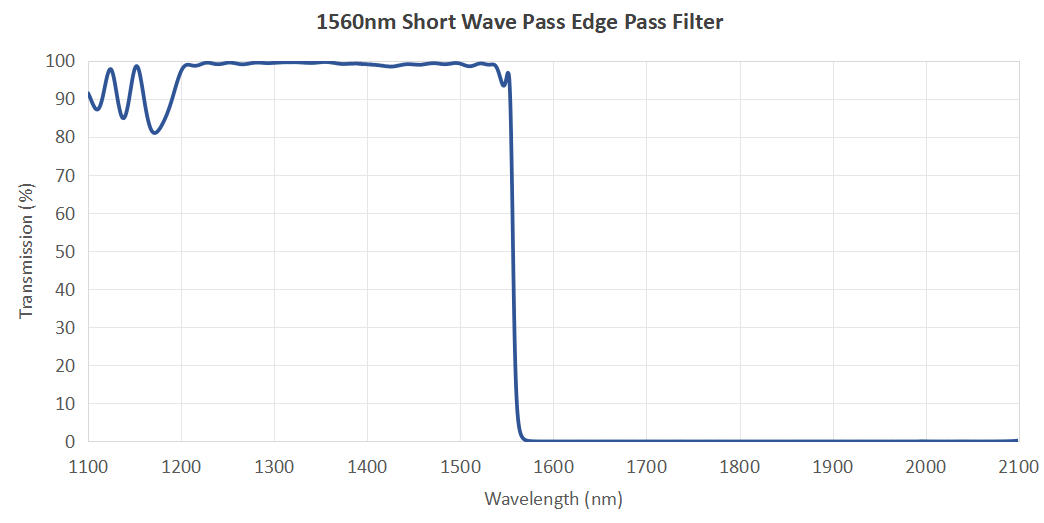
1560nm Short Wave Pass Edge Pass Filter Specification
- 50% cut off:1560+/-10nm
- 1580-2100nm@OD6 blocking depth
- Tp>=95%@1200-1540nm
Stock List Of Optical Edge Filter
| Filter | 50% Cut Off wavelength | Transmission Peak(T%) | High Transmission Range (nm) | Blocking Range (nm) | Blocking depth (T%) |
|---|---|---|---|---|---|
| Shortpass Filter 455nm | 455 | 85 | 380-445 | 470-750 | OD4 |
| Shortpass Filter 490nm | 490 | 90 | 500-765 | 340-485 | OD4 |
| Shortpass Filter 490nm | 490 | 90 | 400-480 | 510-650 | OD3 |
| Shortpass Filter 505nm | 505 | 90 | 400-500 | 520-1000 | OD3 |
| Shortpass Filter 600nm | 600 | 90 | 400-590 | 610-1200 | OD4 |
| Shortpass Filter 650nm | 650 | 95 | 400-640 | 665-1100 | OD4 |
| Shortpass Filter 650nm | 650 | 90 | 420-630 | 670-1100 | OD2 |
| Shortpass Filter 650nm | 650 | 95 | 400-535 | 665-1020 | OD5 |
| Shortpass Filter 650nm | 650 | 95 | 400-635 | 660-1000 | OD2 |
| Shortpass Filter 650nm | 650 | 90 | 420-620 | 680-1100 | OD2 |
| Shortpass Filter 650nm | 650 | 95 | 400-640 | 665-1100 | OD5 |
| Shortpass Filter 675nm | 675 | 90 | 400-650 | 700-1100 | OD2 |
| Shortpass Filter 690nm | 690 | 90 | 420-685 | 710-1100 | OD3 |
| Shortpass Filter 690nm | 690 | 90 | 330-685 | 705-1200 | OD1 |
| Shortpass Filter 690nm | 690 | 90 | 420-650 | 730-1100 | OD2 |
| Shortpass Filter 700nm | 700 | 95 | 400-690 | 715-1080 | OD5 |
| Shortpass Filter 700nm | 700 | 90 | 400-685 | 725-1100 | OD4 |
| Shortpass Filter 700nm | 700 | 90 | 200-385 | 725-1100 | OD2 |
| Shortpass Filter 700nm | 700 | 95 | 400-690 | 720-1200 | OD3 |
| Shortpass Filter 705nm | 705 | 90 | 400-695 | 720-1100 | OD3 |
| Shortpass Filter 710nm | 710 | 90 | 400-700 | 725-1100 | OD3 |
| Shortpass Filter 710nm | 710 | 95 | 550-700 | 740-1100 | OD4 |
| Shortpass Filter 720nm | 720 | 95 | 410-690 | 730-1100 | OD2 |
| Shortpass Filter 720nm | 720 | 95 | 410-690 | 730-1100 | OD2 |
| Shortpass Filter 730nm | 730 | 95 | 400-720 | 740-1100 | OD2 |
| Shortpass Filter 730nm | 730 | 95 | 400-720 | 740-1100 | OD2 |
| Shortpass Filter 750nm | 750 | 90 | 500-730 | 780-1100 | OD5 |
| Shortpass Filter 750nm | 750 | 94 | 400-735 | 770-1100 | OD3 |
| Shortpass Filter 750nm | 750 | 95 | 420-740 | 760-1200 | OD6 |
| Shortpass Filter 800nm | 800 | 90 | 400-790 | 820-1100 | OD2 |
| Shortpass Filter 800nm | 800 | 90 | 400-790 | 820-1100 | OD2 |
| Shortpass Filter 830nm | 830 | 90 | 450-800 | 960-1200 | OD5 |
| Shortpass Filter 890nm | 890 | 90 | 500-850 | 980-1520 | OD2 |
| Shortpass Filter 895nm | 895 | 95 | 400-885 | 915-1350 | OD3 |
| Shortpass Filter 900nm | 900 | 95 | 400-895 | 930-1150 | OD3 |
| Shortpass Filter 980nm | 980 | 90 | 600-960 | 1000-1200 | OD5 |
Coligh Customize Capability Of Cutoff Filter
We possess independent R&D, coating production, and mass delivery capabilities, supporting both small-batch prototyping and large-scale delivery. Utilizing hard dielectric coating technology, edge wavelengths, transmission bands, cutoff bands, cutoff depths, and transition bands can be optimized according to customer optical paths, and we can provide measured spectral curves and test reports. We also support integrated customization of wavelength, bandwidth, size, incident angle, and mounting structure.
| Customization Parameter | Available Range & Options |
|---|---|
| Wavelength Options | • UV range from 160-400nm (such as 365nm, 380nm, 390nm, 400nm) |
| Wavelength allowance | Within 5nm for cut off wavelength |
| Blocking range | 200-1100nm or custom according to request |
| Blocking depth | Standard OD4 - OD5, up to OD6 |
| High UV Transmission | • High transmission in UV band: 85%, 90% |
| Substate | UV low-autofluorescence Fused Silica |
| Size dimension | 2-150mm |
| AOI Customization | 0°-45° |
| Mounting Options | Mounted in black anodized aluminum rings or unmounted |
| Surface Quality | 60-40, 40-20 |
| Thin film coating technology | • Ion-Assisted Deposition (IAD) hard thin-films |
1560nm Edge Pass Filter Applications
Optical Communication Systems
In optical communication systems, the 1550 nm (C-band) is typically used to carry service signals, while in-service monitoring via Optical Time-Domain Reflectometry (OTDR) often employs longer wavelengths—such as 1625 nm or 1650 nm—to avoid interfering with the service channels. A 1560 nm short-pass edge filter allows for high transmission of the 1550 nm service band (on the short-wavelength side) while providing high rejection of the 1625/1650 nm monitoring signals (on the long-wavelength side), thereby enabling the separation of service traffic from the OTDR monitoring path.
Erbium-Doped Fiber Lasers (EDFLs) and Nonlinear Optics (Ultrashort Pulses)
Erbium-doped fiber lasers generally operate within the 1530–1565 nm range. Ultrashort pulses and nonlinear optical processes—such as Raman scattering or supercontinuum generation—can produce spurious components at longer wavelengths. A 1560 nm short-pass edge filter transmits the desired EDFL signals while blocking unwanted long-wavelength components (e.g., Raman-shifted light, long-wavelength Amplified Spontaneous Emission (ASE), or the long-wavelength tail of a supercontinuum spectrum), thereby enhancing spectral purity and the signal-to-noise ratio (SNR).
1550 nm Eye-Safe LiDAR and Remote Sensing
1550 nm eye-safe LiDAR and remote sensing systems operate in the vicinity of 1550 nm. Their receivers require high transmission of the 1550 nm return signal while suppressing long-wavelength background interference, such as atmospheric background radiation (1600–1700 nm), thermal radiation, and stray light. A 1560 nm short-pass edge filter transmits the 1550 nm return signal while blocking background noise at wavelengths above 1560 nm; this improves the SNR of the return signal and helps mitigate detector saturation and noise. In remote sensing applications, such filters are used to isolate the 1550 nm detection band from long-wavelength background interference.