220-380nm T50:R50 UV Beamsplitter
220-380nm UV beamsplitter transmit 50% and reflect 50% of the UV light. Coligh customs and manufactures UV laser beamsplitter plate for various applications.
220-380nm T50:R50 UV Beamsplitter Overview
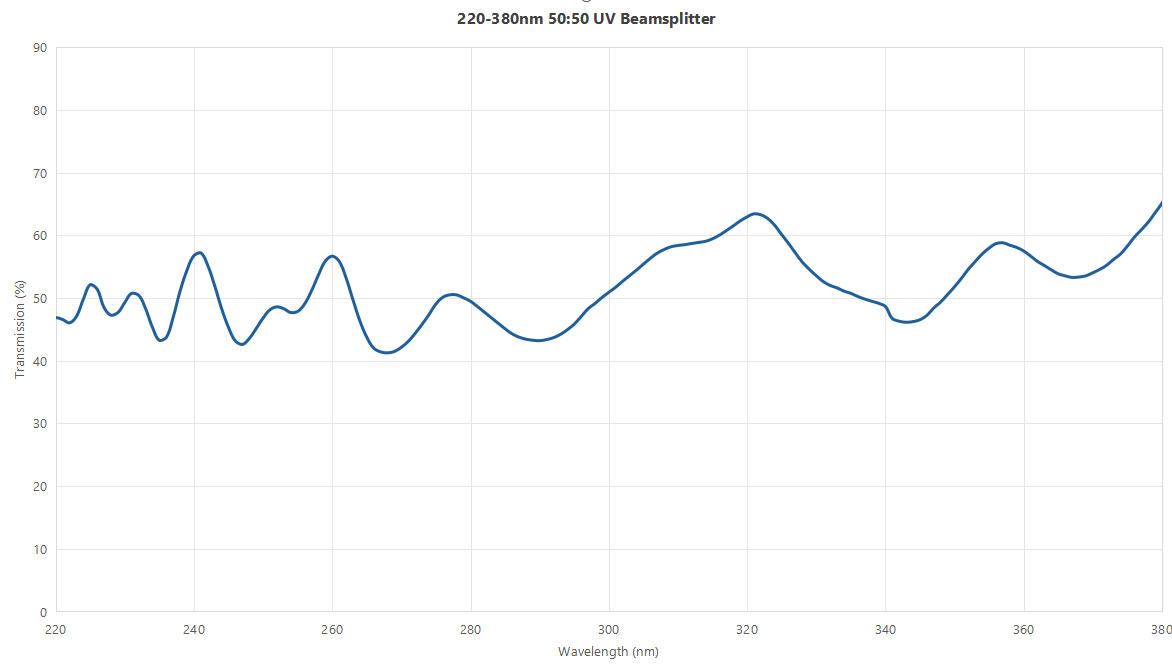
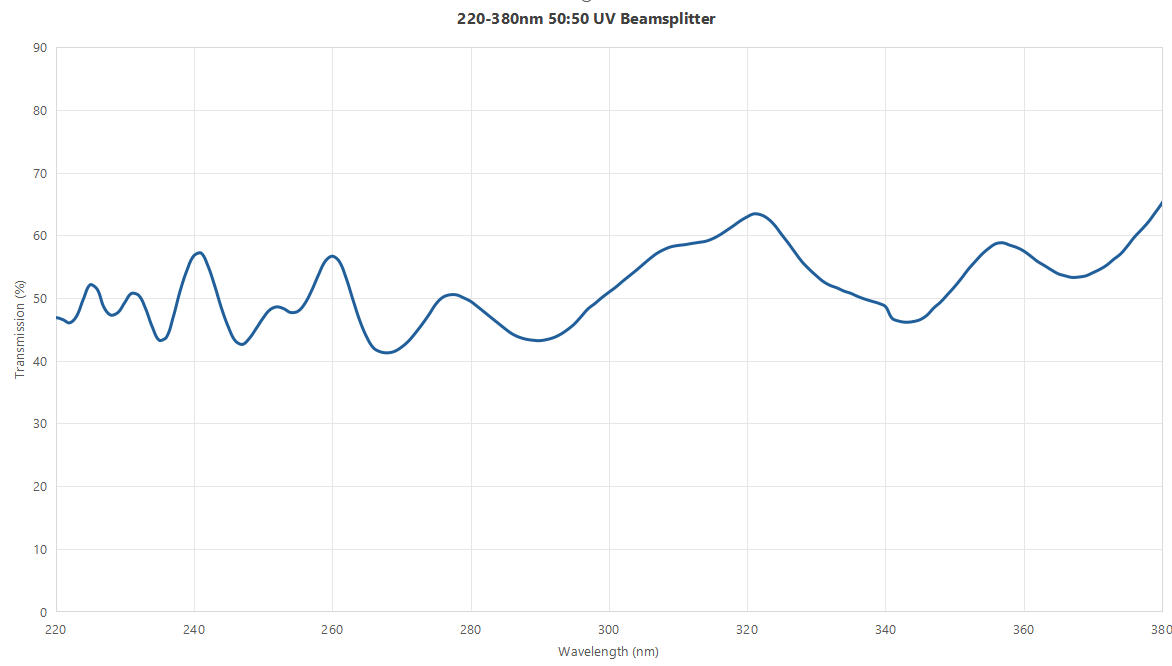
This 220–380 nm broadband UV plate beamsplitter is specifically designed for optical systems requiring uniform beam splitting across the full UVC and UVA spectral range. It features a 50:50 broadband dielectric beamsplitting coating on a fused silica substrate and a broadband anti-reflective coating on the back surface, ensuring that the energy of the transmitted and reflected beams is approximately equal (50% each) within the 220–380 nm range. The beamsplitter is suitable for applications involving long-term exposure to high-intensity light sources, such as deuterium lamps and UV lasers.
The spectrum Curve Of 220-380nm T50:R50 UV Beamsplitter
220-380nm T50:R50 UV Beamsplitter Technical Specifcation
- Beamsplitter wavelength: 220-380nm
- Transmission and reflection: 50:50+/-10%
- Material: Fused silica
- Angle of incidence: 45deg
- Size: 80*80*1.0.7mm or custom
- AR coating: Back side
- Thin film coating: Dielectric hard coating
Other UV Beamsplitter In Stock List:
| Working wavelength range | T/R | AOI | Size Dimension |
|---|---|---|---|
| 400-900nm | 50/50 | 45° | 25.4*1.0mm |
| 400-900nm | 50/50 | 45° | 25.4*1.0mm |
| 400-700 nm | 24/76 | 45° | 60*60*1.0mm |
| 400-700 nm | 30/70 | 45° | 25.2*35.6*1mm |
| 400-700nm | 30/70 | 45° | 60*60*1.0mm |
| 200-1100nm | 50/50 | 45° | 60*60*1mm |
| 200-1100nm | 45/55 | 45° | 25*60*1mm |
| 200-1100nm | 45/55 | 45° | 25.2*35.6*1 |
| 220-380nm | 50/50 | 45° | 80*80*0.7mm |
| 200-370nm | 50/50 | 45° | 80*80*0.7mm |
| 400-700nm | 50/50 | 45° | 70*5mm |
| 220-380nm | 50/50 | 45° | 25*36*1.1mm |
| 240-460nm | 50/50 | 45° | 150*150*1mm |
| 1000-1100nm | 50/50 | 45° | D15*3mm |
Customization Capability of UV Laser Beamsplitter
| Customization Item | Capability Range |
|---|---|
| Product Type | UV Beam Splitter Plate, UV Partial Reflector, UV Dichroic Beam Splitter, UV Laser Beam Splitter |
| Wavelength Range | UV spectrum customization from 160–400 nm (EUV / UV-C / UV-B / UV-A available) |
| Center Wavelength | Customized wavelengths, such as 193 nm, 248 nm, 266 nm, 308 nm, 355 nm, 365 nm, 405 nm, or wideband |
| Beam Splitting Ratio | Custom reflection/transmission ratio, such as 50/50, 30/70, 20/80, 10/90 |
| Coating Type | UV dielectric beam splitter coating, ion-assisted deposition (IAD) hard coating |
| Substrate Material | UV fused silica, JGS1/JGS2 quartz glass |
| Operating Angle | 45° |
| Surface Quality | 40/20, 60/40 scratch-dig standards |
| Surface Flatness | λ/4, λ/6 precision available |
| AR Coating | UV anti-reflection coating available |
| Laser Damage Threshold | High-LIDT coating design available for UV range |
| Edge Treatment | Fine grinding, chamfering, protective edge processing |
220-380nm T50:R50 UV Beamsplitter Applications
Dual-beam UV-Vis spectrophotometer.
In water quality analysis and biochemical protein concentration detection, the output intensity of broadband UV light sources (such as deuterium lamps) fluctuates slightly due to changes in time and temperature. Without real-time compensation for light source intensity across the 220–380 nm detection range, instrument baseline drift occurs, leading to measurement inaccuracies at trace concentration levels. A 220–380 nm beamsplitter can eliminate system errors caused by light source instability.
UV fluorescence microscope.
Observing internal cellular structures requires the use of various fluorescent dyes. A 220–380 nm broadband UV beamsplitter accommodates multiple UV excitation sources, enabling coaxial illumination and observation, as well as the excitation of diverse biomolecules using a broadband UV light source.
Semiconductor wafer defect inspection.
266 nm and 355 nm are common UV laser wavelengths used in semiconductor inspection and micro/nano-fabrication. A 220–380 nm broadband UV beamsplitter can reflect 1%–5% of the UV laser energy to a power meter for real-time closed-loop control of the laser’s output power, while allowing more than 95% of the energy to be transmitted to the workpiece.