230-900nm Wideband UV Laser Beamsplitter Plate 45R:55T
230-900nm Wideband UV Laser Beamsplitter Plate is a beamsplitter work with 45% reflection and 55% transmission at 230-900nm range. Coligh customs and manufactures wideband laser beamsplitter with specific dimensions, shapes, and specialized spectral.
230-900nm Wideband UV Laser Beamsplitter Plate 45R:55T Overview
230-900nm wide band UV laser beamsplitter plate is an beamsplitter works at 230-900nm with 45% reflection and 55% transmission. We use fused silica as substrate material to fabricate. It maintains highly consistent, neutral spectral performance across the 230 nm to 900 nm range. Customization is available for specific dimensions, shapes, and specialized spectral characteristics.
The spectrum Curve Of 230-900nm Wideband UV Laser Beamsplitter Plate 45R:55T
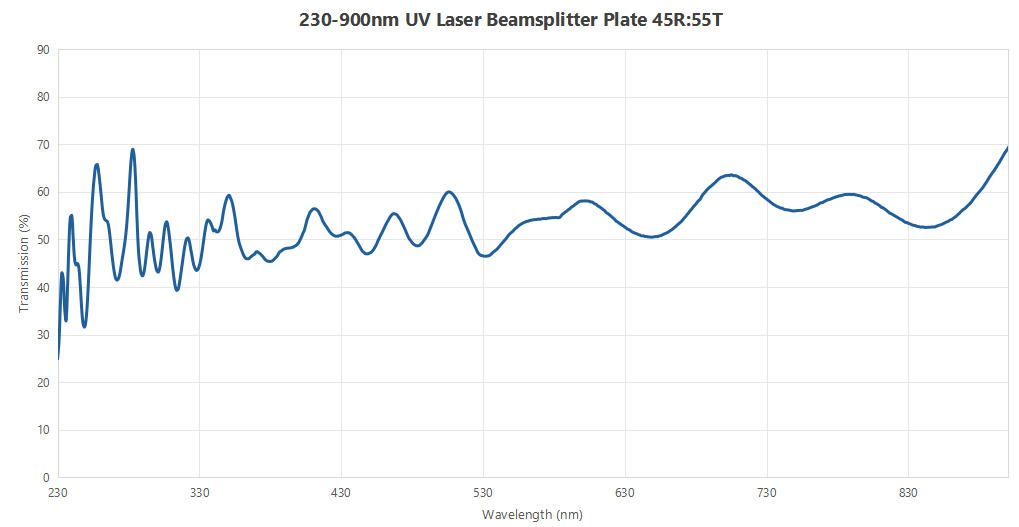
230-900nm Wideband UV Laser Beamsplitter Plate 45R:55T Technical Specifcation
- Beamsplitter wavelength: 230-900nm
- Transmission and reflection: 45:55+/-10%
- Material: Fused silica
- Angle of incidence: 45deg
- Size: 80*80*1.0.7mm or custom
- AR coating: Back side
- Thin film coating: Dielectric hard coating
Other UV Beamsplitter In Stock List:
| Working wavelength range | T/R | AOI | Size Dimension |
|---|---|---|---|
| 400-900nm | 50/50 | 45° | 25.4*1.0mm |
| 400-900nm | 50/50 | 45° | 25.4*1.0mm |
| 400-700 nm | 24/76 | 45° | 60*60*1.0mm |
| 400-700 nm | 30/70 | 45° | 25.2*35.6*1mm |
| 400-700nm | 30/70 | 45° | 60*60*1.0mm |
| 200-1100nm | 50/50 | 45° | 60*60*1mm |
| 200-1100nm | 45/55 | 45° | 25*60*1mm |
| 200-1100nm | 45/55 | 45° | 25.2*35.6*1 |
| 220-380nm | 50/50 | 45° | 80*80*0.7mm |
| 200-370nm | 50/50 | 45° | 80*80*0.7mm |
| 400-700nm | 50/50 | 45° | 70*5mm |
| 220-380nm | 50/50 | 45° | 25*36*1.1mm |
| 240-460nm | 50/50 | 45° | 150*150*1mm |
| 1000-1100nm | 50/50 | 45° | D15*3mm |
Customization Capability of UV Laser Beamsplitter
| Customization Item | Capability Range |
|---|---|
| Product Type | UV Beam Splitter Plate, UV Partial Reflector, UV Dichroic Beam Splitter, UV Laser Beam Splitter |
| Wavelength Range | UV spectrum customization from 160–400 nm (EUV / UV-C / UV-B / UV-A available) |
| Center Wavelength | Customized wavelengths, such as 193 nm, 248 nm, 266 nm, 308 nm, 355 nm, 365 nm, 405 nm, or wideband |
| Beam Splitting Ratio | Custom reflection/transmission ratio, such as 50/50, 30/70, 20/80, 10/90 |
| Coating Type | UV dielectric beam splitter coating, ion-assisted deposition (IAD) hard coating |
| Substrate Material | UV fused silica, JGS1/JGS2 quartz glass |
| Operating Angle | 45° |
| Surface Quality | 40/20, 60/40 scratch-dig standards |
| Surface Flatness | λ/4, λ/6 precision available |
| AR Coating | UV anti-reflection coating available |
| Laser Damage Threshold | High-LIDT coating design available for UV range |
| Edge Treatment | Fine grinding, chamfering, protective edge processing |
230-900nm Wideband UV Laser Beamsplitter Plate 45R:55T Applications
Spectrophotometers
Spectrophotometers typically employ deuterium and tungsten-halogen light sources to cover the full 230–900 nm wavelength range. Standard beamsplitters can cause energy attenuation in the ultraviolet region. A broadband beamsplitter covering 230–900 nm ensures uniform beam splitting across this wide range, thereby enhancing the instrument’s accuracy.
Multi-wavelength Fluorescence Microscopes
In multiplexed fluorescence imaging—where excitation and emission wavelengths span the ultraviolet, visible, and near-infrared regions—frequently changing beamsplitters can lead to optical path misalignment. A 230–900 nm broadband beamsplitter directs multi-wavelength excitation light onto the biological sample while simultaneously transmitting the weak fluorescence signals.
Broadband Tunable Laser Systems
Femtosecond lasers, optical parametric oscillators (OPOs), and supercontinuum sources output laser light with extremely broad spectra spanning hundreds of nanometers. When sampling or distributing the energy of these high-energy beams, the dispersion effects of standard optical components can distort the spectral profiles of the transmitted and reflected light. A 230–900 nm broadband beamsplitter allows broadband laser light to be transmitted and reflected into spectrometers or beam profilers.