340nm UV Shortpass Filter
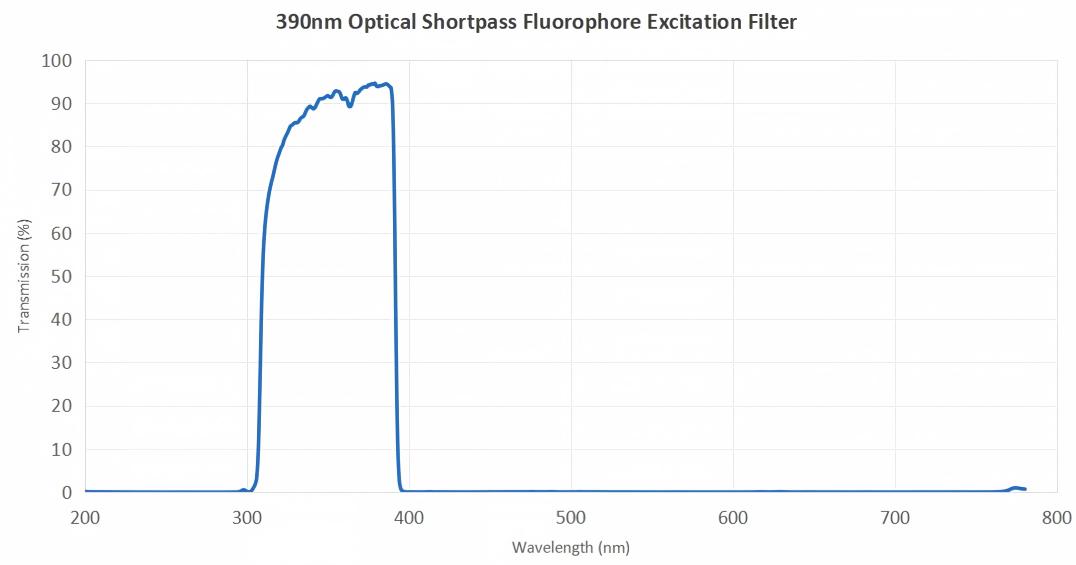
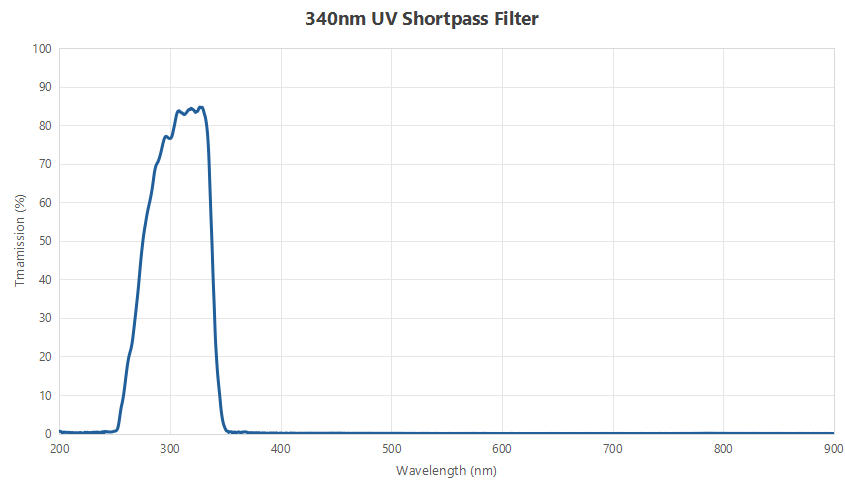
340nm UV shortpass filter is an optical UV filter to block longer wavelength than 340nm and transmit the light within 250-330nm. Coligh customs and manufactures various UV bandpass filters, shortpass filters and dichroic filter. Contact us for more detail.
340nm UV Shortpass Filter Overviews
The 340nm UV shortpass filter is an optical filter designed to cut off wavelengths at 340nm. It efficiently transmits ultraviolet radiation below 340nm while blocking longer-wavelength UV, visible, and near-infrared light. Constructed using a UV-grade fused silica substrate and a hard dielectric coating, the filter offers excellent UV durability, low autofluorescence, and a high damage threshold. It is suitable for applications such as fluorescence excitation, UV spectroscopy, photolithography, and medical diagnostics.
The Characteristic Of 340nm UV Shortpass Filter
- Broad-spectrum coverage (UVC, UVB, and UVA) with an average transmittance exceeding 80%
- Maintains an optical density (OD) of over 4 across the 350–650 nm range, effectively blocking visible light
- Hard dielectric coating on a fused silica substrate; resistant to UV-induced aging and high-power UV sources, ensuring no transmittance degradation during long-term operation
340nm UV Shortpass Filter Technical Datasheet
- Cut off wavelength: 340+/-5nm
- HT>80%@250-330
- HR average OD4@350-650
- Size stock avaiable: D24*2mm 60*60*2mm
Spectrum of 340nm UV Shortpass Filter
Custom Capability Of UV Edge Filter
| Item | Customization Capability |
|---|---|
| Operating Range | UV 200–400 nm |
| Cut-off Wavelength | 200 nm / 220 nm / 240 nm / 254 nm / 280 nm / 300 nm / 320 nm / 350 nm / 365 nm / 400 nm, or customized |
| Transmission Band | 160–400 nm UV-C / UV-B / UV-A range customizable |
| Peak Transmission | ≥80% or above (customizable according to requirements) |
| Blocking Performance | OD2–OD6+ customizable |
| Substrate Material | Fused Silica / UV Grade Quartz |
| Shape | Square and round shapes available |
| Surface Quality | 60-40, 40-20 available |
| Surface Flatness | λ/4, λ/6 available |
| Parallelism | ≤3 arc min (optimized version available) |
| AR Coating | UV Anti-Reflection (AR) coating available |
| Angle of Incidence | 0° / 15° / 30° or customized |
| Laser Damage Threshold | Customizable according to laser application requirements |
| Coating Technology | Ion Assisted Coating (IAC) technology |
340nm UV Shortpass Filter Application
UV Fluorescence Microscopy Imaging
Common fluorescent dyes such as DAPI and Hoechst have optimal excitation peaks near 358 nm or 360 nm, yet their absorption bands extend into the short-wave UV region below 340 nm. Mercury lamps or LED light sources used for fluorescence imaging often emit intense spectral lines at 365 nm, 405 nm, or even within the visible range. If this long-wave light enters the excitation path, it can pass directly through the dichroic mirror or overlap with the fluorescence emission spectrum, resulting in excessive background noise. A 340 nm short-pass filter placed in the excitation path allows only short-wave UV (250–330 nm) to reach the sample—exciting the dye to produce blue/cyan fluorescence—while completely blocking long-wave UV (above 350 nm), visible light, and infrared radiation.
Photolithography
Semiconductor photolithography and certain precision UV curing processes rely on short-wave UV for high-resolution exposure. High-pressure mercury lamps and UV-LED sources have broad spectra containing long-wave lines such as 365 nm, 405 nm, and 436 nm; these wavelengths can cause light diffusion and reduce pattern resolution. Installing a 340 nm short-pass filter—positioned after the integrator in the mask aligner or curing optical path and before the mask/workpiece—purifies the light path. It ensures that only short-wave UV (250–330 nm) participates in the exposure process, while completely cutting off wavelengths above 350 nm.
Water Quality Analysis
Determining the UV254 absorbance and Chemical Oxygen Demand (COD) of organic matter in water requires precise measurement of absorption at 254 nm. However, actual water samples may contain suspended solids and macromolecules that cause light scattering and visible light absorption. Inserting a 340 nm short-pass filter between the cuvette and the photodetector—or integrating it into the flow cell optical path of an online analyzer—ensures that only short-wave UV (250–330 nm) reaches the detector, effectively suppressing all long-wave stray light.