940nm/20nm Bandwidth NIR Narrowband Filter | Custom NIR Filter Manufacturer
Oligh customs and manufactures 940nm NIR narrowband filter. Our 940/20nm narrow bandpass filter is specially design and optimize for 3D sensing, ToF, Face recognition, and Laser LiDAR applications.
940nm/20nm Bandwidth NIR Narrowband Filter Overview
The 940/20nm bandwidth NIR narrowband filter is an optical filter with a 940nm core wavelength (CWL) and a 20nm field-of-view (FWHM). The high transmission range of this filter is 930-950nm. It allows 940nm VCSELs and IR LEDs to pass through while suppressing visible light, 850nm light, sunlight, and other stray light from the environment, thereby improving the system’s signal-to-noise ratio and measurement accuracy. Therefore, it is widely used in 3D sensing, ToF cameras, facial recognition, machine vision, LiDAR, AR/VR, and industrial inspection.
Coligh, as a manufacturer of near-infrared narrowband filters, produces and customizes optical filters according to customer requirements. We support the entire production process from film system design to spectral detection. We can customize film systems based on the customer’s VCSEL wavelength, field of view, and detector size.
940nm/20nm Bandwidth NIR Narrowband Filter Product Features
- It has the following core features:
- A center wavelength of 940nm, with a free wavelength (FWHM) of 20nm, perfectly matching VSCEL light sources or other IR LEDs.
- High transmittance in the 930-950nm range allows for lossless passage of 940nm.
- Outside-band cutoff depth OD5, also capable of OD6. Hard dielectric multilayer film suitable for long-term use.
940nm/20nm Bandwidth NIR Narrowband Filter Manufacturer Spectrum
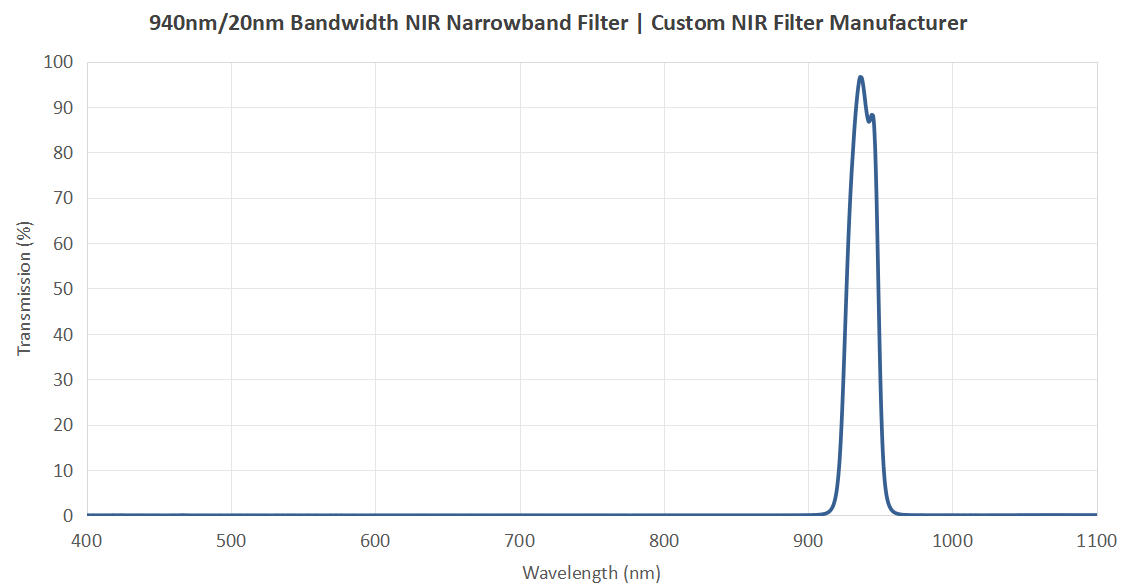
940/20nm Infrared Interference Filter Specification
- CWL:940+/-3nm
- FWHM: 20+/-3nm
- Tp>=90%
- Blocking: 200-1100nm@OD5
Coligh Customize Capability Of Hard-Coated IAD NIR Filter
As a direct optical filter manufacturer, we offer comprehensive OEM/ODM customization services for the 940/20nm narrowband filter and other spectral bands. Whether you need a specific substrate, custom dimensions , or strict optical density blocking, our engineering team can deliver high-performance solutions designed precisely for your laser, biomedical, or sensing systems.
| Parameter | Customization Options |
|---|---|
| Center Wavelength (CWL) | 160–20,000 nm |
| FWHM (Bandwidth) | 0.5–200 nm |
| Shape / Dimensions | Round, square, and custom geometries |
| Thickness | 0.21, 0.30, 0.50, 0.55, 0.70, 1.0, 1.1, 1.5, and 2.0 mm |
| Peak Transmittance (Tpeak) | Optimized according to application requirements |
| Blocking / Optical Density (OD) | OD2–OD6+, customizable |
| Substrate Materials | Optical glass, fused silica, B270, sapphire |
| Angle of Incidence (AOI) | 0–60° |
| Laser Damage Threshold (LIDT) | Optimized according to application and laser-power requirements |
940/20nm Infrared Glass Filter Applications
3D Sensing and ToF Cameras
3D sensing and ToF modules typically use a 940 nm VCSEL to emit infrared light, and the detector needs to receive only the 940 nm echo. Ambient light, sunlight, and other infrared light can reduce depth measurement accuracy. A 940 nm/FWHM 20 nm narrowband filter can match the VCSEL wavelength while suppressing background light. This improves depth measurement accuracy and immunity to ambient light, and reduces power consumption.
Face Recognition and Biometrics
Face recognition, iris recognition, and vein recognition use 940 nm illumination, which allows operation in low light and reduces visible light interference. However, sunlight, incandescent light, and other infrared light sources in the environment can enter the recognition camera, reducing recognition rate and security. A 940 nm/FWHM 20 nm narrowband filter allows only 940 nm illumination light to pass through, suppressing interference from other wavelengths. Suitable for security equipment such as mobile phones, access control, and payment systems.
Machine Vision
Machine vision systems often use 940 nm invisible illumination to reduce light pollution and red exposure. However, ambient light, sunlight, and workshop lighting can enter the camera, reducing image contrast. Narrowband filters allow 940 nm light to pass through while suppressing visible light and out-of-band infrared, improving the image signal-to-noise ratio. They also improve low-light imaging brightness and contrast, reduce ambient light interference, and are suitable for security monitoring, industrial inspection, logistics barcode scanning, and concealed lighting.
LiDAR and Near-Infrared Ranging
When 940 nm LiDAR and near-infrared ranging systems operate outdoors, the detector receives sunlight, ambient infrared light, and long-wave background light, reducing ranging accuracy and detection range. Narrowband filters allow only 940 nm echoes to pass through, suppressing other wavelengths, improving detection range, ranging accuracy, and resistance to background light, while reducing noise and bit error rate.