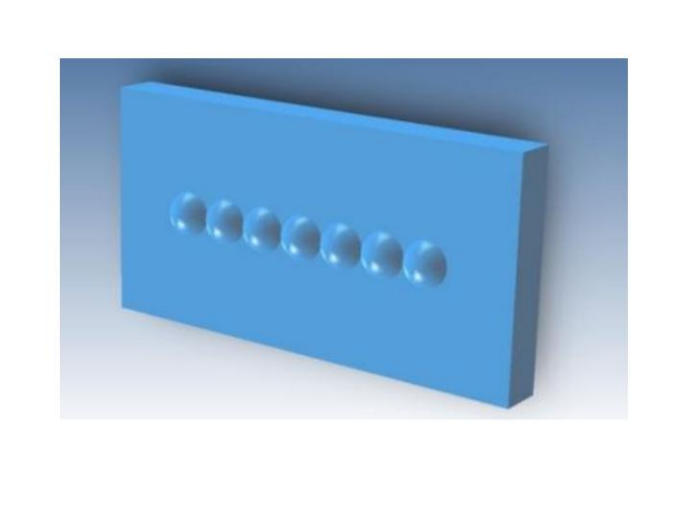
14-Channel 1550nm Microlens Array for Fiber Collimator
Coligh is a China-based manufacturer of fiber collimation microlens arrays. We provide customized design and production of one-dimensional microlens arrays for optical fibers according to customer requirements.
Microlens Array for Fiber Collimator Product Overview
Microlens arrays play an important role in fiber collimation, as they can simultaneously collimate multiple fibers. In multi-channel optical communication systems, they convert the divergent beams emitted from each fiber into parallel collimated beams. Microlens arrays can be used for coupling between laser sources, coupling between fiber arrays and waveguide arrays, and can also be applied in optical multiplexing and optical switching.
Coligh focuses on the production of fiber-coupling collimation microlens arrays. We currently offer a standard 14-channel one-dimensional linear microlens array for fiber coupling and collimation, and can also customize 4-channel, 8-channel, and 16-channel microlens arrays according to customer requirements.
Our Optical Fiber Micro Lens Array Product Features
- Our current standard product is a one-dimensional multi-channel linear microlens array.
- The microlens array is plano-convex.
- The standard fiber microlens array is 1×14, and can be customized to 1×16, 1×4, or 1×8.
- Design wavelengths are 1310nm and 1550nm, and a high-transmittance antireflection coating is available.
- The substrates are fused silica and silicon.
- The divergence angle is small, and it features a high numerical aperture and excellent aberration correction. This improves fiber-to-fiber coupling efficiency.
- It can also improve fiber-to-chip coupling efficiency.
- Minimizes light loss during alignment and transmission, improving coupling performance.
The Advantage Of Our Fiber Microlens Arrays
Our linear microlens arrays have significant advantages in optical fiber communication:
- Low beam pointing error ensures stable transmission of optical signals
- High coupling efficiency between fiber and light source, as well as fiber and detector, reducing energy loss
- High uniformity of array focal length, with each lens unit having consistent imaging performance
- High transmittance and extremely low scattering, providing good signal-to-noise ratio for communication systems
- Fiber array collimation capability, enabling simultaneous collimation of multi-core fiber arrays
- Supports high-performance data communication such as DWDM, optical interconnection, and data center applications
Different Fiber Microlens Arrays Collimator Substrate
| Material | Advantages in Microlens Arrays for Fiber Optic Communications |
|---|---|
| Silicon Wafers | - Extremely high transmittance in near-infrared and mid-infrared |
| - Higher refractive index than fused silica, enabling thinner microlens arrays | |
| - Can be directly integrated with silicon-based devices | |
| - Silicon wafers can serve as substrate for V-groove arrays | |
| - Photolithography allows precise V-groove etching, ensuring stable fiber core alignment | |
| Fused Silica Substrates | - High transmittance from ultraviolet to infrared, covering key telecom wavelengths (1310nm & 1550nm) with minimal optical loss |
| - Low coefficient of thermal expansion, stable against temperature fluctuations | |
| - Excellent stability in diverse operating environments | |
| - High laser damage threshold, suitable for high-power laser applications |
The Application Of Fiber Collimator Micro Lens Array
The primary function of a fiber collimator micro-array lens is to convert diverging optical beams in an optical fiber into parallel beams, or to efficiently couple parallel light into an optical fiber. It has a wide range of applications:
- In DWDM systems, fiber collimator micro-array lenses can collimate the beams of multiple DWDM channels to receivers or OADMs.
- In optical networks, they are used for optical switching and optical cross-connects (OXCs) to perform optical path switching.