Optical Dual-Bandpass IR Cut Filter (Visible & 850nm NIR) For Machine Vision
Coligh manufactures and custom Optical Dual-Bandpass IR Cut Filter which can work for visible light and 850nm at the same time. This multi bandpass filter can work for machine vision, industrial camera, day and night surveillance.
Optical Dual-Bandpass IR Cut Filter (Visible & 850nm NIR) For Machine Vision Overview
The Optical Dual-Bandpass IR Cut Filter (Visible & 850nm NIR) is a multi-bandpass filter. Its dual-bandpass design, allowing transmission of both visible and 850nm near-infrared wavelengths while blocking unwanted infrared radiation, enables machine vision systems to flexibly switch between visible light and 850nm NIR imaging. Therefore, it is primarily used in machine vision, industrial cameras, agricultural sorting, and logistics barcode scanning applications.
This filter employs a hard dielectric multilayer film design, offering high transmittance in the 400-650nm range, with an 850nm near-infrared passband of approximately 70nm and a transmittance of ≥90%. Its out-of-band cutoff is OD3-OD4.
It possesses the following core features:
- Visible light and 850nm dual-bandpass imaging
- Extremely high transmittance: visible light transmittance ≥90%, 850nm peak transmittance ≥90%
- Effective blocking of stray light in the 700-800nm and 900-1100nm ranges
- Good environmental stability and abrasion resistance due to the characteristics of a
- hard dielectric multilayer film, suitable for long-term useA variety of substrates are available, such as B270, D263T, and Rongrong Quartz.
Coligh is a manufacturer of dual-bandpass filters. We can support the entire production process from film system design, coating, substrate treatment, cutting, cleaning to assembly and spectral detection. Extensive customization experience enables us to provide highly consistent filters and a stable long-term supply.
Optical Dual-Bandpass IR Cut Filter (Visible & 850nm NIR) For Machine Vision Spectrum
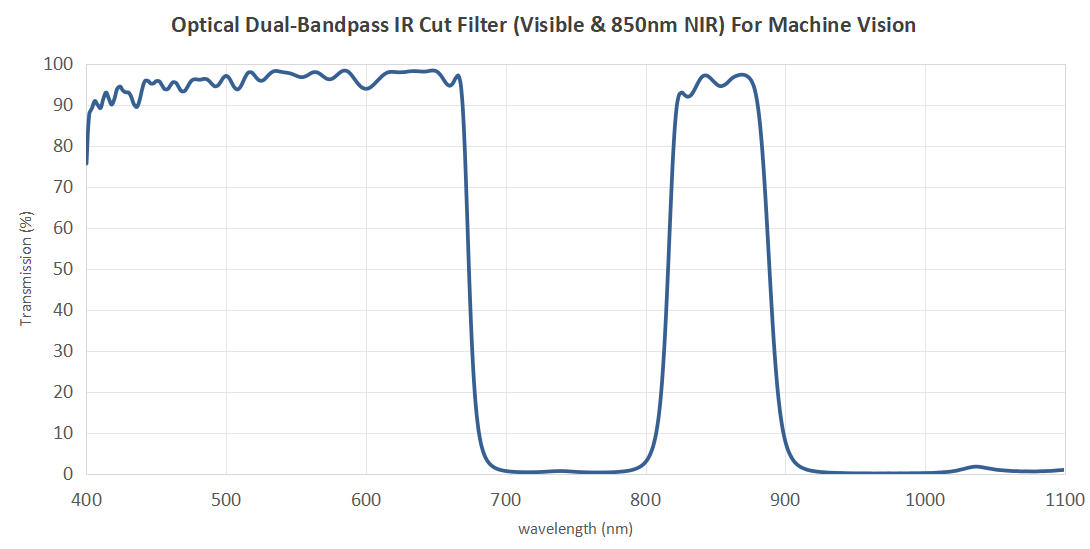
Optical Dual-Bandpass IR Cut Filter (Visible & 850nm NIR) For Machine Vision Specifcation
- 400-670nm@T>=90%
- 700-800nm@blocking OD3 average
- 850/70nm bandpass filter with 90% transmission
- 920-1100nm@OD>=2
Coligh Customize Capability Of Dual Band Pass Optical Filter
As an experienced optical filter manufacturer, we offer highly flexible customization to meet a wide range of optical and photonic applications. Two independently specified transmission bands can be designed and optimized according to your application, including center wavelength, bandwidth (FWHM), peak transmittance, blocking range, substrate, dimensions, AOI, and laser damage threshold.
| Specification | Band 1 | Band 2 |
|---|---|---|
| Center Wavelength (CWL) | 160–20000 nm | 160–20,000 nm |
| FWHM | 0.5–200 nm | 0.5–200 nm |
| Peak Transmittance | >=90% | >=90% |
| Blocking / OD | OD2–OD6+ | OD2–OD6+ |
Optical Dual-Bandpass IR Cut Filter (Visible & 850nm NIR) For Machine Vision Applications
Machine Vision
Machine vision systems often use 850 nm NIR LED illumination in low-light environments because 850 nm is invisible, reducing ambient light interference, and many camera sensors are sensitive to 850 nm. However, ordinary IR cuts block 850 nm, and ordinary IR passes block visible light. Dual bandpass filters can simultaneously retain visible light and 850 nm, enabling day and night operation. This improves low-light imaging brightness and contrast, reduces ambient light interference, and allows a single camera to handle both visible light and NIR imaging.
Industrial Cameras for Day and Night Operation
Industrial inspection sometimes requires visible light color information and sometimes requires 850 nm NIR penetration or identification of hidden features. Dual bandpass filters allow the same camera system to operate in both modes without changing filters or adding a second camera. This reduces equipment changeover time and improves inspection flexibility.
850 nm NIR Illumination Inspection
850 nm NIR illumination is commonly used to detect defects, stains, internal structures, or hidden markings that are difficult to detect under visible light. Dual bandpass filters allow 850 nm echoes to pass through while preserving visible light channels and suppressing other infrared stray light. This improves NIR detection contrast and signal-to-noise ratio, reduces environmental infrared interference, and enhances defect detection rate.